


Prof. Dr. Bela Gipp
Professor for Scientific Information Analytics &
Director of Research at the SUB (State and University Library Göttingen)
BIOGRAPHY
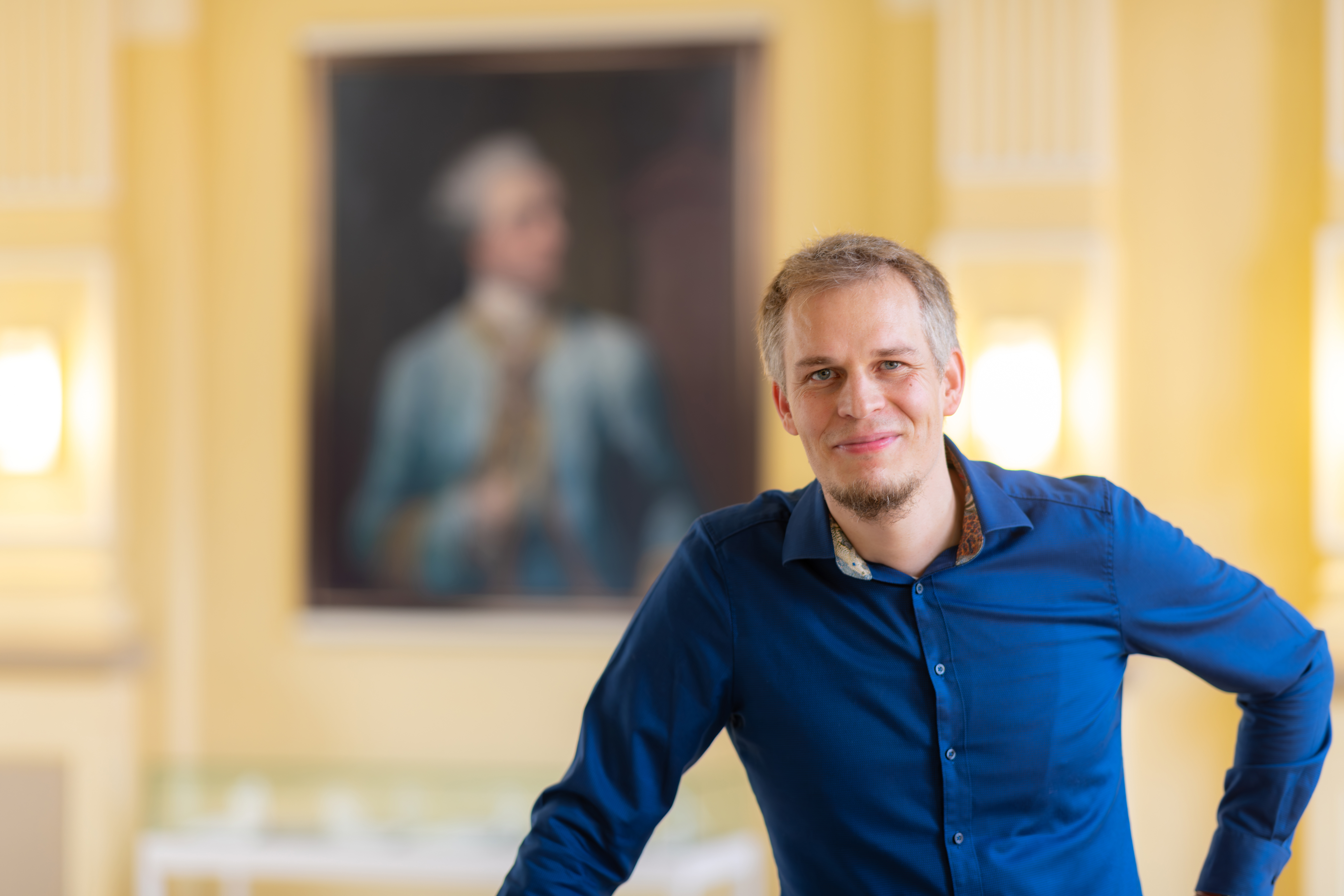
Prof. Bela Gipp (Dr.-Ing.) holds the chair for Scientific Information Analytics at the University of Göttingen, Germany, and is the Director of Research at the Göttingen State and University Library (SUB).
His research interests lie at the intersection of Information Science and Data Science. His group’s research focuses on developing and applying Natural Language Processing (NLP) techniques and methods for retrieving, analyzing, and visualizing information in large datasets. The implications of blockchain technology—for the benefit of both industry and society—is another research domain that Bela is passionate about.
Previously, Bela was a full professor at the University of Wuppertal, where he held the chair for Data & Knowledge Engineering from 2018 to 2022. Before that, Bela served as a junior professor at the University of Konstanz, where he led the Information Science Group from 2015 to 2018. He completed his Ph.D. in Computer Science (summa cum laude) at the University of Magdeburg in 2013. He conducted the majority of his doctoral research abroad while on a 4-year research scholarship at the University of California, Berkeley. While at UC Berkeley, he also made use of the proximity to the Silicon Valley to found the tech start-up SciPlore and co-found Docear. After his Ph.D., he received postdoctoral research fellowships at U.C. Berkeley and the National Institute of Informatics in Tokyo.
In his youth, Bela participated in Jugend Forscht, Germany’s premier youth science competition. After winning 1st place at the state-level competition three times, he was honored by the German Chancellor and Germany’s Federal President. Scholarships allowed him to study semesters abroad in Sydney, Beijing, Staffordshire, and at UC Berkeley. Today, he is involved as a jury member and mentor for Jugend Forscht and tech startups.
Bela has published over 200 peer-reviewed conference papers and journal articles, in addition to several books and patents, which have received more than 10,000 citations; his h-index is approximately 50. Currently, he is the PI of these DFG-funded projects. He has secured over 11 million EUR in third-party funding and venture capital investments for his research thus far. Additionally, he maintains active research collaborations with industry. For example, he founded OriginStamp AG, based in Switzerland.
Bela serves as a DFG-nominated member of the Digitality in Science Initiative of the Alliance of Science Organizations in Germany. He is a member of the scientific advisory board for the DAAD Program offering International Research Stays for Computer Scientists and the internationalization officer of the Institute for Computer Science. In his spare time, Bela enjoys photography, designing, building, and flying innovative drones, and he loves to paraglide in the Alps.
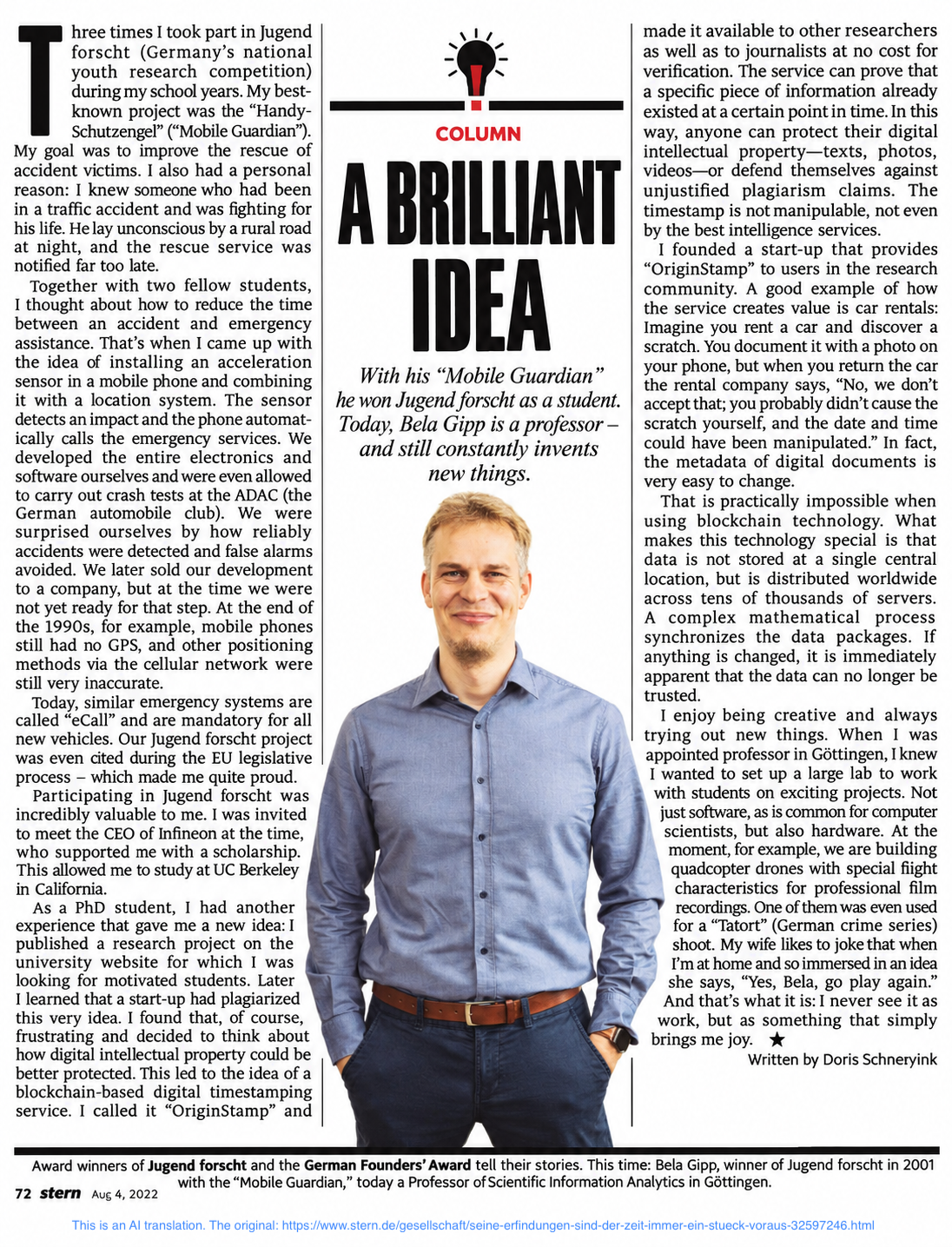
BIOGRAPHY IN STERN 

SHORT CV
Since April 2022
Full Professor (W3) for Scientific Information Analytics
University of Göttingen, Germany
and since June 2024:
Director of Research at the State and University Library Göttingen (SUB)
University of Göttingen, Germany
2018 – 2022
Full Professor (W3) for Data & Knowledge Engineering
Bergische University of Wuppertal, Germany
2018
2015 – 2018
Junior Professor (W1)
Head of the Information Science Group
University of Konstanz, Germany
2014 – 2015
Postdoc
National Institute of Informatics (NII), Tokyo, Japan
2013 – 2014
Postdoc
University of California (UC) Berkeley, USA
2009 – 2013
Research Fellowship
UC Berkeley, School of Information & Department of Statistics, USA
Ph.D. defense in 2013 at the University of Magdeburg, Germany
1999 & 2001 & 2002
Jugend Forscht
1st place at the state level of the German research contest “Jugend Forscht” in the years 1999, 2001, and 2002. Read more in this STERN article or here & here.
The GSM-Schutzengel and Its Influence on the Development of Europe’s Mandatory eCall System
The GSM-Schutzengel (GSM Guardian Angel) was an early automatic vehicle emergency notification system invented by Bela Gipp and developed together with Jöran Beel and Lars Petersen around 2000–2001.
The invention anticipated several fundamental capabilities of modern automatic crash notification systems, particularly the European eCall system, which became mandatory for newly approved passenger-car and light-commercial-vehicle types in the European Union on March 31, 2018.
GSM-Schutzengel demonstrated how automatic accident detection, mobile communication, and cellular-network-based localization could be combined to accelerate emergency response and potentially save lives.
Original project website:
https://gsm-schutzengel.de/
Article in the Braunschweiger Zeitung:
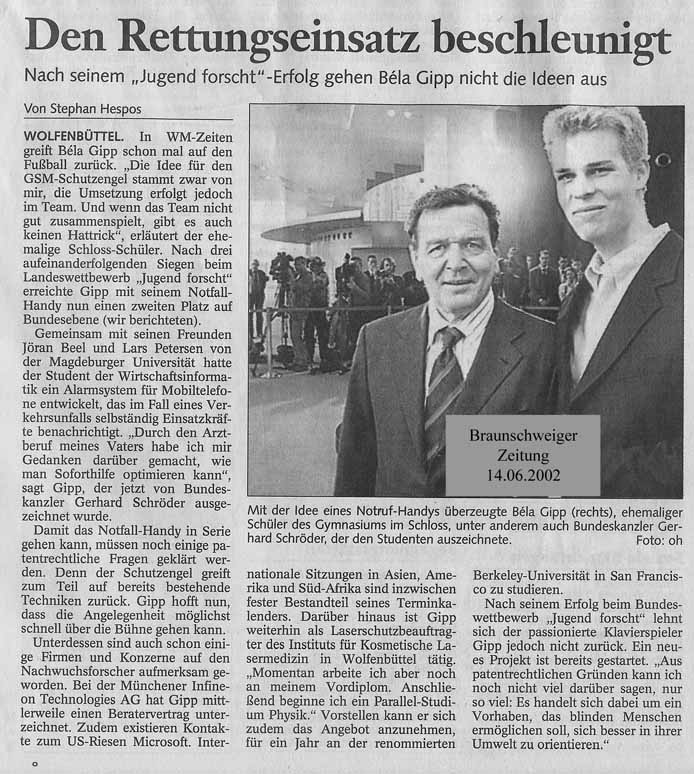
Bela Gipp honored by Chancellor Gerhard Schröder in 2002 after winning Jugend forscht
The Original Innovation: GSM-Schutzengel (2001)
At the beginning of the 2000s, mobile phones were becoming widespread, but automatically detecting vehicle accidents and notifying emergency services was not yet a standard feature.
The GSM-Schutzengel “Jugend forscht” project addressed a critical problem: after a serious accident, occupants may be unconscious, injured, or otherwise unable to contact emergency services. Such situations can cause potentially life-threatening delays in rescue operations.
The invention integrated several innovative technologies into a mobile-phone-based emergency notification system:
- Automatic crash detection: An acceleration sensor integrated into the mobile phone’s battery detected severe impacts.
- Automatic emergency notification: Upon detecting an accident, the system could automatically initiate an emergency alert without requiring action by the vehicle occupants.
- GSM-based localization: The system used cellular-network information to determine an approximate accident location without requiring a dedicated GPS receiver.
- Transmission of additional information: The system could communicate information about the occupants, including medical or other safety-relevant information.
- False-alarm prevention: A cancellation mechanism helped prevent unnecessary emergency notifications.
These capabilities anticipated the basic architecture of modern Automatic Crash Notification (ACN) and Advanced Automatic Crash Notification (AACN) technologies.
The project was presented at the German youth research competition Jugend forscht in 2001 and received second prize at the national competition in 2002.
Further information:
Original GSM-Schutzengel technical project description.
The Development of European eCall
The European Union subsequently developed eCall, a standardized vehicle emergency notification system based on the same fundamental concept: automatically detecting serious vehicle accidents, establishing an emergency communication connection, and transmitting location and vehicle information to emergency services.
The major milestones are:
2001: GSM-Schutzengel Demonstrated
Bela Gipp and his collaborators presented the GSM-Schutzengel system, combining automatic accident detection, GSM-based location identification, and mobile emergency communication.
2002–2003: European eSafety Initiatives
The European Commission advanced its eSafety initiative, focusing on intelligent vehicle safety technologies and interoperable emergency communication. By 2003, the development of a European-wide eCall system had become an important policy objective.
2004: Commercial Transfer of GSM-Schutzengel Technology
Following further development and successful testing, several intellectual-property rights and research results from the GSM-Schutzengel project were sold to a company in the United States in March 2004.
The original project website documents this development:
GSM-Schutzengel project history and milestones.
2015: European eCall Regulation
The European Union adopted Regulation (EU) 2015/758, establishing requirements for installing 112-based eCall systems in newly approved vehicle types.
2018: eCall Becomes Mandatory
From March 31, 2018, new types of passenger cars and light commercial vehicles covered by the regulation must include a compliant eCall system to obtain EU type approval.
Official legislation:
Regulation (EU) 2015/758.
Technical Similarities Between GSM-Schutzengel and eCall
Although the technologies differ in implementation and standardization, GSM-Schutzengel already demonstrated several functions that characterize modern eCall systems.
| Capability | GSM-Schutzengel (2001) | European eCall (2018) |
|---|---|---|
| Automatic accident detection | Accelerometer-based impact detection | Vehicle-integrated crash detection |
| Automatic emergency notification | Mobile-network-based notification | Automatic 112 emergency call |
| Accident localization | GSM cellular-network positioning | Primarily satellite-based positioning (GNSS) |
| Additional information | Occupant and medical information | Standardized minimum set of vehicle and incident data |
| Manual intervention | Mechanism for cancelling false alarms | Manual emergency-call activation and standardized handling |
| Implementation | Mobile-phone-based prototype | Standardized vehicle-integrated system |
The central technological concept is shared: a vehicle accident should automatically trigger an emergency notification containing sufficient information to help emergency responders locate and assist the victims, even when the occupants cannot call for help themselves.
Recognition in Academic Literature
The historical relationship between GSM-Schutzengel and European eCall has also been discussed in academic literature.
In the 2017 publication “NotrufPlus – ein standort- und internetbasiertes Notruf-Kommunikationssystem”, Manuel Eckert discusses the historical emergence of eCall and refers to GSM-Schutzengel as an early project from the 2001 Jugend forscht competition, followed by European eSafety developments.
This provides an independent academic reference recognizing GSM-Schutzengel in the historical context of automatic emergency notification.
Academic source:
Read the 2017 publication (PDF).
The Lasting Legacy of GSM-Schutzengel
GSM-Schutzengel was an early demonstration of a technological concept that is now an important element of modern automotive safety: detecting a serious accident automatically, identifying its location, and transmitting an emergency notification without depending on conscious intervention by the vehicle occupants.
Its significance lies in three aspects:
- Early technical innovation: The system demonstrated automatic accident detection and cellular emergency notification years before European eCall became mandatory.
- Practical feasibility: The invention showed how existing mobile-phone and GSM infrastructure could provide a potentially life-saving service.
- Historical influence and recognition: The project has been discussed in academic literature in connection with the emergence of eCall, and its intellectual-property rights and research results were subsequently transferred commercially to the United States.
The original system and the modern eCall infrastructure are technically distinct, but they address the same fundamental objective: reducing the time between a serious accident and the arrival of emergency assistance.
GSM-Schutzengel can consequently be described as an early technical precursor of today’s automatic vehicle emergency-call systems, including Europe’s mandatory eCall technology.
Historical References and Further Reading
- Original GSM-Schutzengel website:
https://gsm-schutzengel.de/ - Original technical project description:
GSM-Schutzengel technical documentation - Project timeline and commercialization:
GSM-Schutzengel project milestones - Official Jugend forscht project archive:
Der GSM-Schutzengel - Academic publication (2017):
NotrufPlus – ein standort- und internetbasiertes Notruf-Kommunikationssystem - European eCall legislation:
Regulation (EU) 2015/758
Conclusion
Invented by Bela Gipp and developed with Jöran Beel and Lars Petersen, GSM-Schutzengel was an early contribution to the technological evolution of automatic vehicle emergency notification.
Its central principles anticipated essential functionality of European eCall, which became mandatory for newly approved vehicle types in 2018.
Learn more about the original invention:
GSM-Schutzengel – Official Project Website.
CURRENT THIRD-PARTY PROJECTS
| Project Title | Begin – End | PI & (PM) at GippLab |
Funding Source |
|---|---|---|---|
| Digitalization Professorship Scientific Information Analytics |
04/22 – 12/28 | Gipp (Meuschke) |
MWK |
| Development of an Innovative AI-based Recommender System in the Chemical Process Industry Based on an Innovative Domain-Adaptive Multilingual Language Model (SPELL) |
01/24 – 02/27 | Gipp (Kirstein) |
BMWE |
| Fake News Detection in Video and Text | 04/25 – 12/26 | Gipp (Wahle, Ruas) |
KIPOT |
| Development of a novel, user-centered, multimodal multi-agent assistance system for first-time plannable, descriptive, and reproducible workflows aimed at process optimization and the development of continuous improvement measures in the process industry. |
08/25 – 11/27 | Gipp (Wahle) |
BMWE |
| Researching with Derivatives: Solutions for Providing Rights-Protected Materials Online |
12/25 – 11/27 | Gipp (Kurzawe) |
DFG |
| AI in Museums | 12/25 – 11/27 | Gipp (Wahle, Ruas) |
MWK |
| LibraryAI — Explorative Development and Testing of a Virtual Library Research Assistant Application |
12/25 – 11/28 | Gipp (Meuschke, Wahle, Ruas) |
DFG |
| Library Automation through AI Technologies | 08/25 – 08/28 | Gipp (Kurzawe) |
MWK |
| Edition, Artificial Intelligence, and Lexicography Interdisciplinary Approaches and Digital Methods for Working with Early New High German Texts |
12/25 – 11/29 | Gipp (Wahle, Ruas) |
MWK |
| Digital Geochemical Data Infrastructure (DIGIS) for GEOROC 2.0 |
01/26 – 12/28 | Gipp (Kurzawe) |
DFG |
| Establishment of a network and services for research information |
01/26 – 12/28 | Gipp (Dogan) |
MWK |
| Opening, Profiling, and Expansion of the Bibliometrics Competence Network, Subproject: Open Research Information Stewardship and Competence Pooling | 01/26 – 12/28 | Gipp (Jahn) |
BMFTR |
| Paraphrase Types: A New Paradigm for Paraphrase Generation and Detection |
03/26 – 02/29 | Ruas (Wahle) |
DFG |
| TextLPG – Exploratory Research of Text as a Labeled Property Graph |
04/26 – 03/29 | Gipp (Dogan) |
DFG |
| The Bias Analysis Research Infrastructure (BARI) | 05/26 – 04/29 | Gipp (Spinde) |
DFG |
| Digital Media Workflow II: Cooperative Data Infrastructures for AI and TDM |
07/26 – 06/29 |
Gipp (Dogan) |
DFG |
| Cultural Heritage for Artificial Intelligence (CHAI) | 01/27 – 12/28 | Gipp (Kurzawe) |
DFG |
| Research Oriented Sustainable Software (ROSS) | 03/27 – 02/30 | Gipp (Dogan) |
MWK |
NEWS
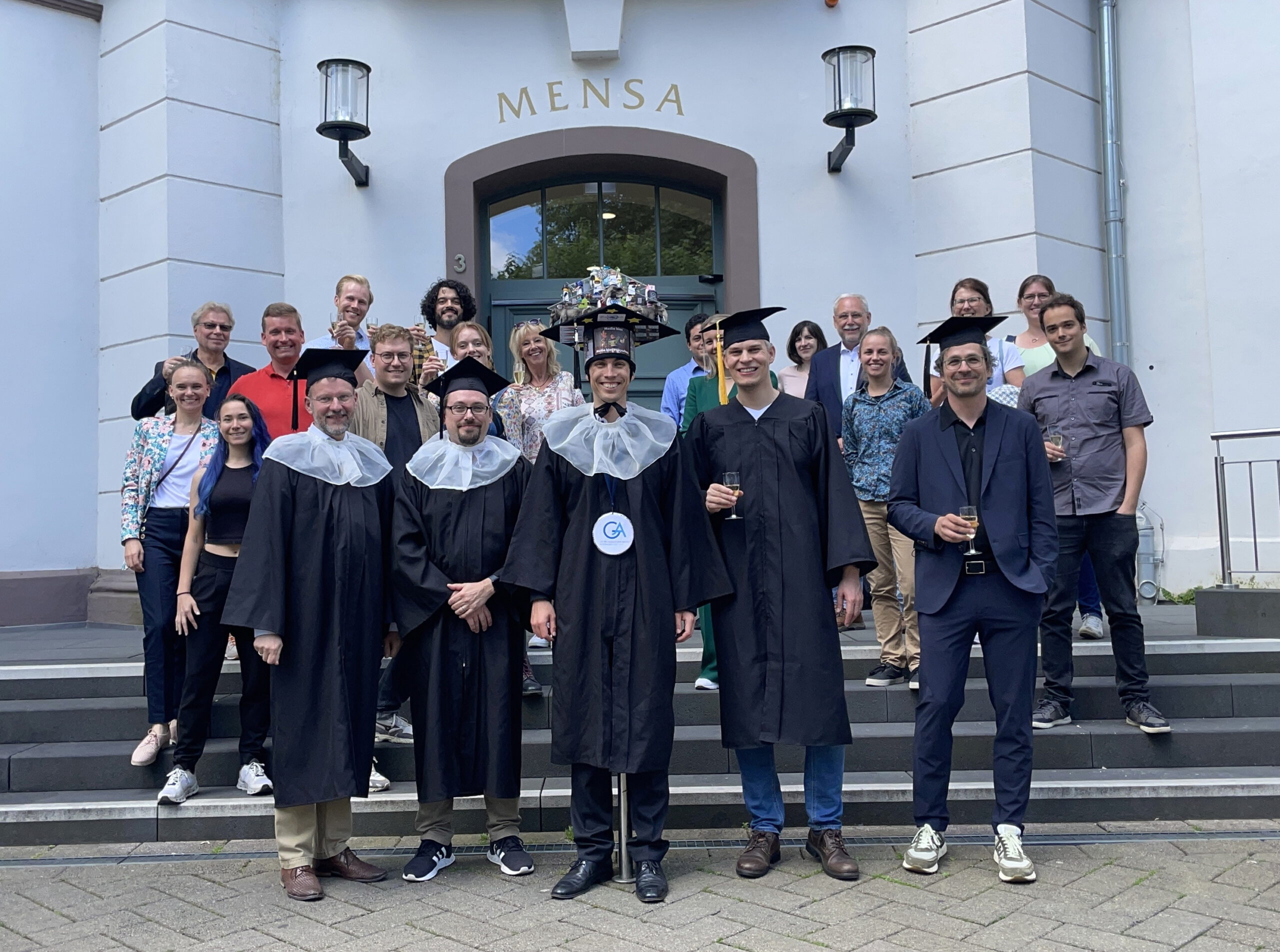
Congratulations to Timo Spinde on his successful PhD thesis defense
We are thrilled to announce that Timo Spinde has successfully defended his PhD thesis titled Automated Detection of Media Bias in News Articles: From the Conceptualization of Media Bias to its Computational Classification. In the presence of his family, friends, [...]
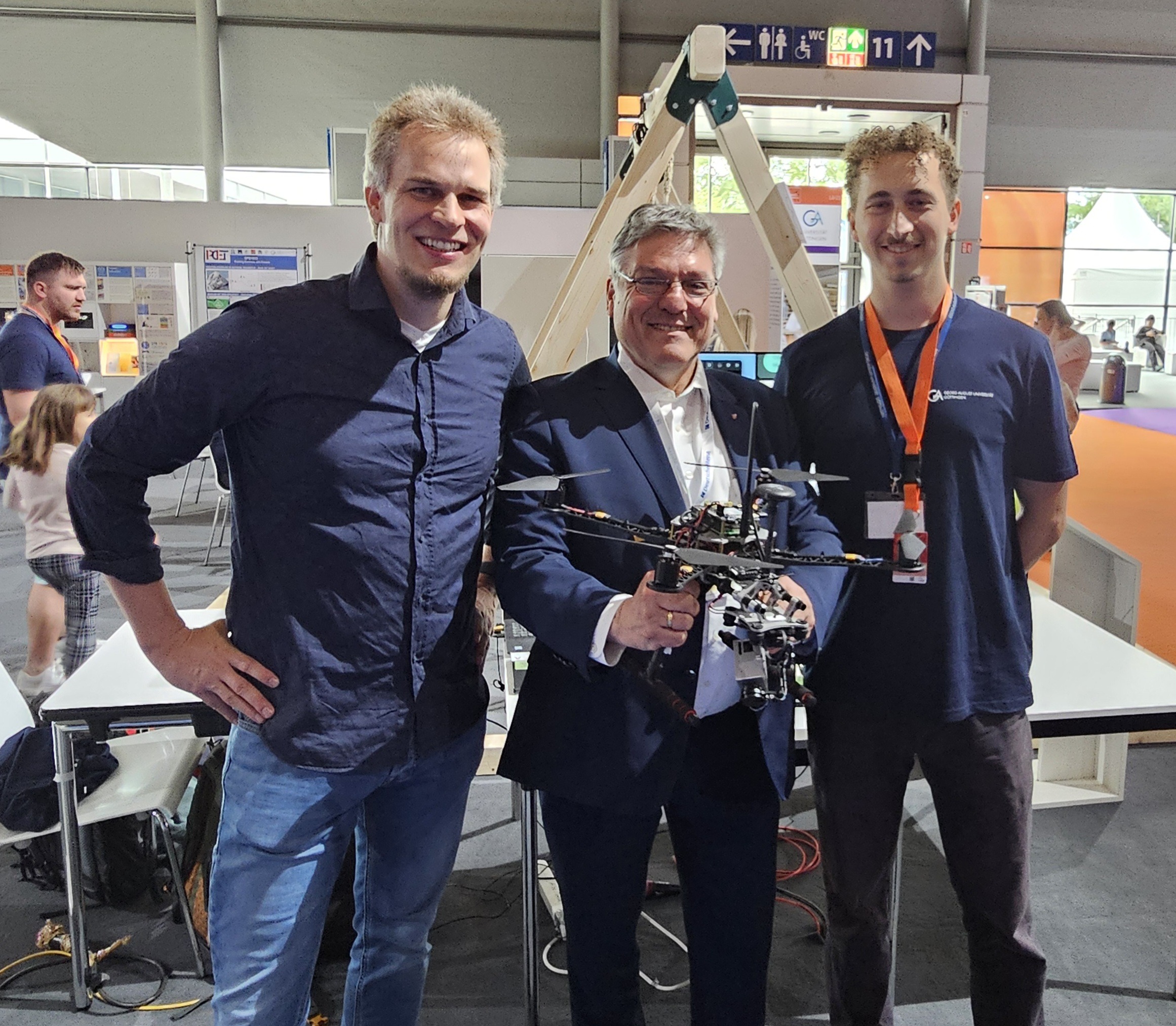
GippLab showcases its FPV Quadcopter Technology for Automated Fawn Rescue at IdeenExpo
Our group showcased its research on automated fawn rescue using self-designed, built, and programmed FPV quadcopters at the IdeenExpo fair in Hanover from June 8 to 16. The State Secretary in the Lower Saxony Ministry of Science and Culture, Prof. [...]
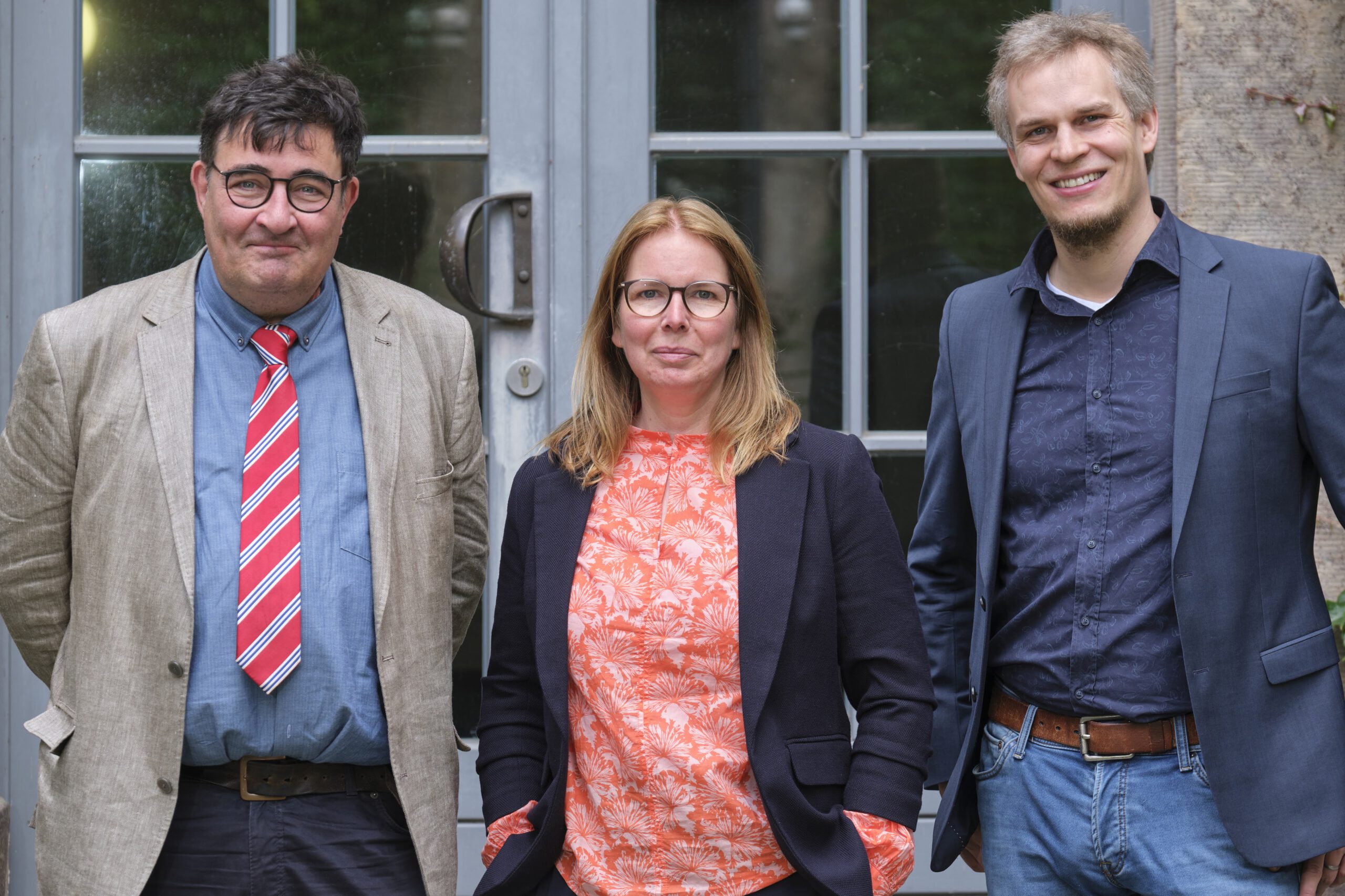
New SUB leadership: Bela Gipp appointed Scientific Director
The State and University Library Göttingen (SUB) will receive new leadership. Prof. Dr. Thomas Kaufmann and Prof. Dr. Bela Gipp will take over as the Director and Scientific Director, respectively. The Head of Library Operations, Kathrin Brannemann, and a soon-to-be-appointed [...]

Call for Research Internships at the National Institute of Informatics, Tokyo
The National Institute of Informatics (NII) in Tokyo—Japan's premiere research institute for computer science—invites master's and Ph.D. students from computer science-related programs at the University of Göttingen to apply for paid research internships. Key Facts Projects: Apply for up to [...]

Research stays of students and researchers at the National Institute of Informatics in Tokyo
On April 15, 2024, Prof. Dr. Emmanuel Planas gave a talk on opportunities for fully funded research stays at the National Institute of Informatics (NII) in Tokyo, Japan, for master's students, PhD candidates, and postdoctoral researchers in Computer Science, Data [...]

GippLab-supported business start-up project tegami.ai secures funding
We are excited to announce that the business start-up project tegami.ai, which our group hosts and supports, has secured funding for one year by receiving an Exist Business Start-up Grant. The founding team consists of Fei Wu, Tomáš Horych, Christoph [...]
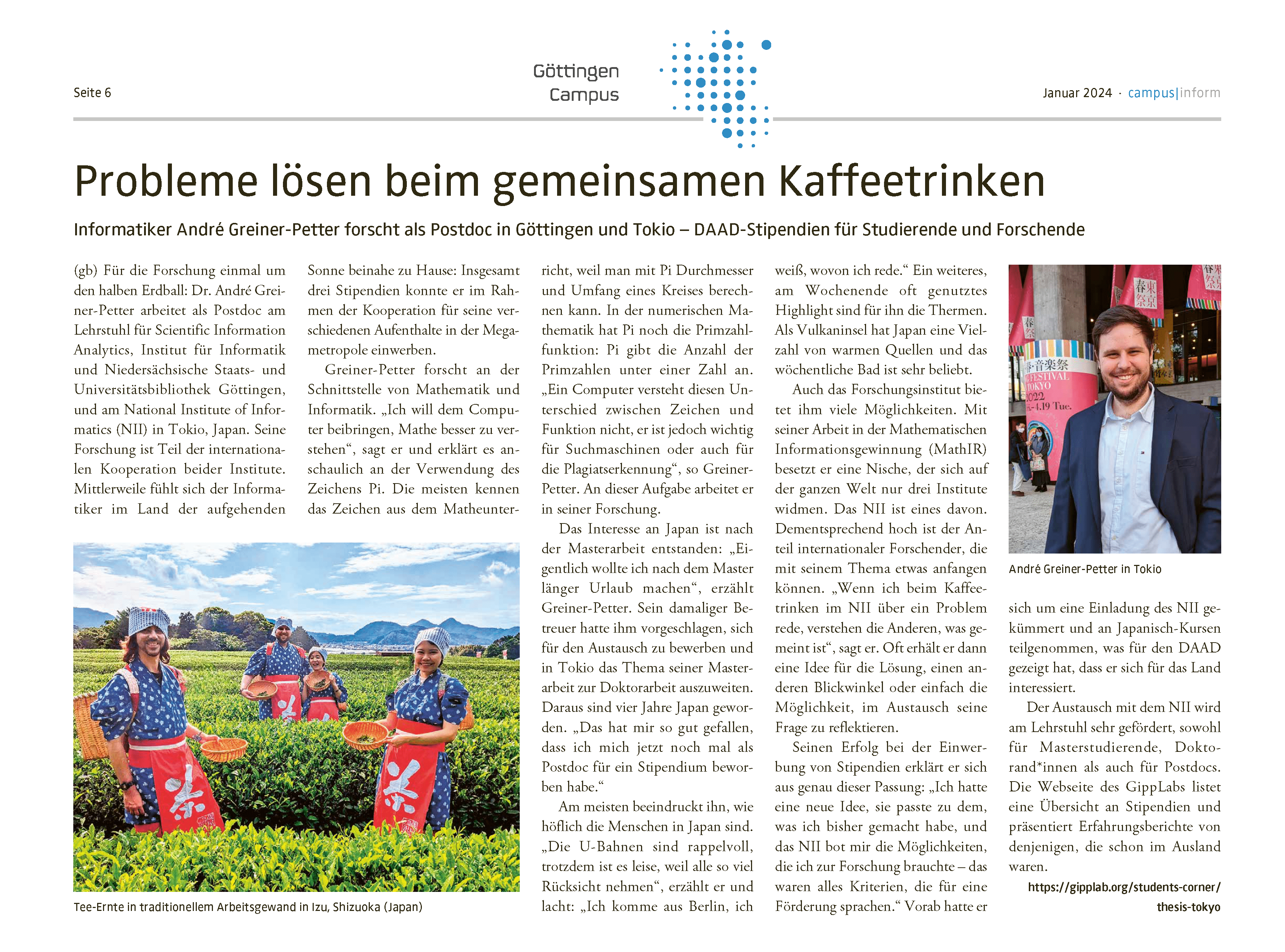
Interview of André Greiner-Petter about his research stays in Tokyo
In the latest issue of campusinform, our group member André Greiner-Petter reports on his research stays in Tokyo, experiences in Japan, and the DAAD scholarship programs he benefitted from and recommends to others. Visit this page to learn more about [...]
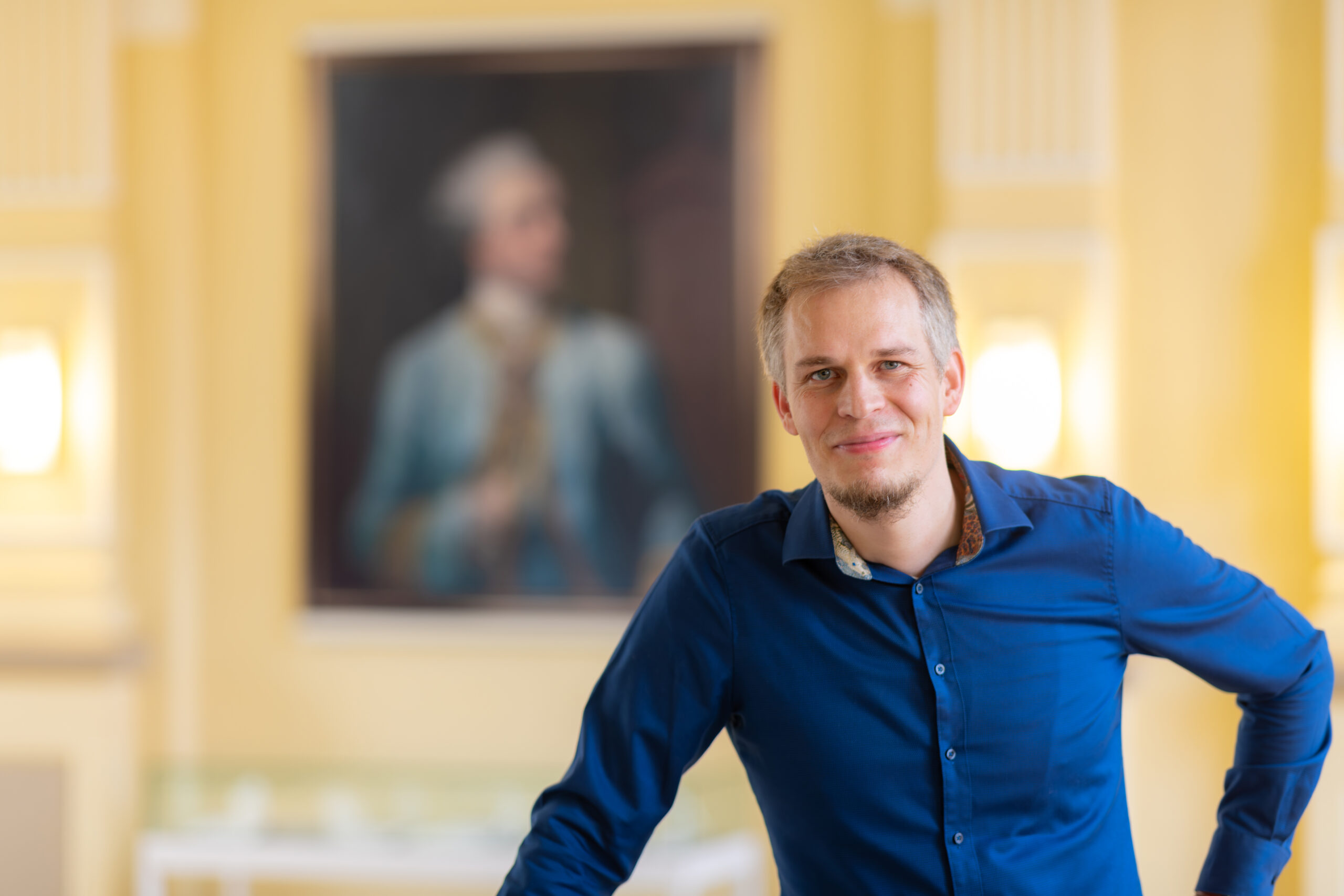
Bela serves as a DFG-nominated member of the Digitality in Science Initiative of the Alliance of Science Organizations
At the invitation of the DFG, Bela Gipp will participate in the Alliance focus area ‘Digitality in Science’ from 2024 onwards. The objectives are described here: Digital tools and their development, including artificial intelligence and machine learning Digital science depends [...]
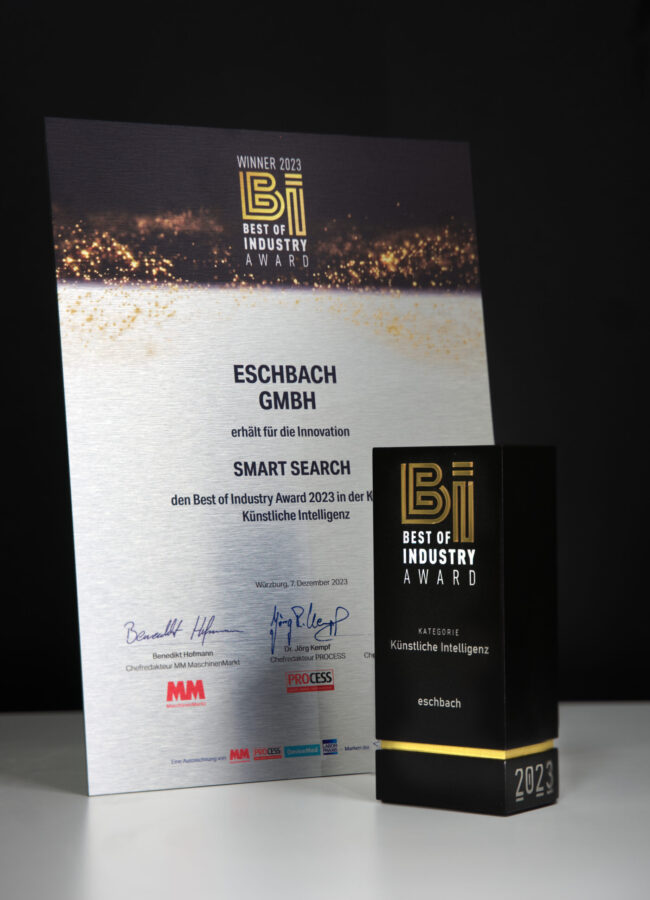
Collaborative AI project with our industry partner eschbach wins Best of Industry Award
The Smart Search functionality our group helped to devise and integrate into the flagship product of our longstanding industry partner eschbach won the Best of Industry Award 2023 in the Artificial Intelligence category. Smart Search is integrated into Shiftconnector—eschbach's enterprise [...]

ACL 2023 – Neural Machine Translation for Mathematical Formulae
Authors: Felix Petersen, Moritz Schubotz, Andre Greiner-Petter, Bela Gipp Contact: Links: Paper The paper received the best video award: https://youtu.be/2JQSgrrltRM?si=f4gjVUvoIhNhj4Z1 Keywords: formula translation, equations, special functions, mathematical language processing, content language, presentation language, latex, semantic latex, mathematica

Faktor Magazine podcast interviews Bela Gipp
The podcast of Faktor Magazine released an episode with Bela Gipp discussing the opportunities and threats of AI, specifically of AI-generated text, in the context of academic research and education. In the interview, Bela touches on some of his current research [...]
Profile of Bela Gipp and his research group
The recently released 2022 Annual Report of Göttingen University introduces Prof. Bela Gipp and his newly established Professorship for Scientific Information Analytics (GippLab) at the Institute for Computer Science and the Niedersächsische Staats- und Universitätsbibliothek Göttingen (SUB). In the interview, [...]
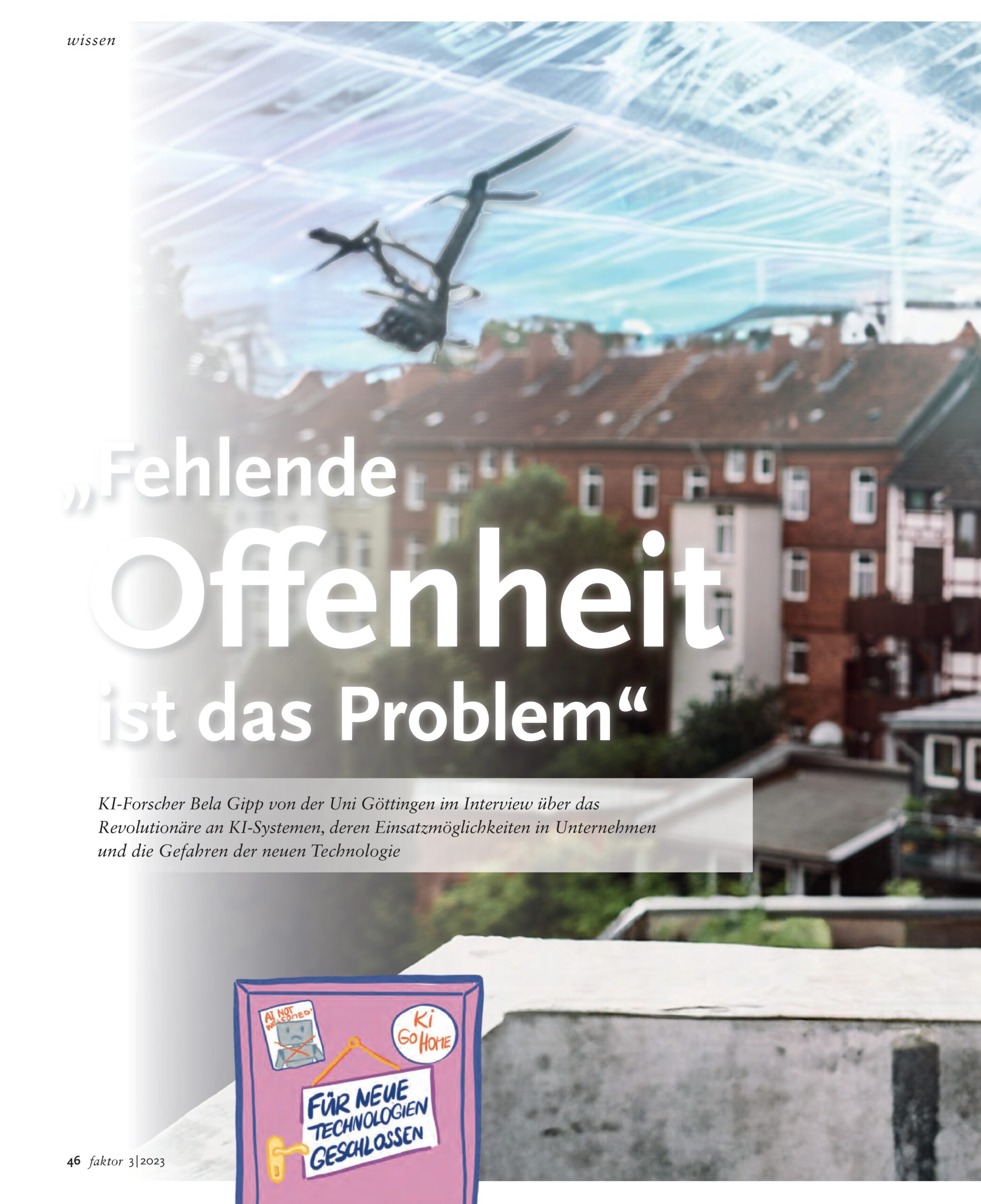
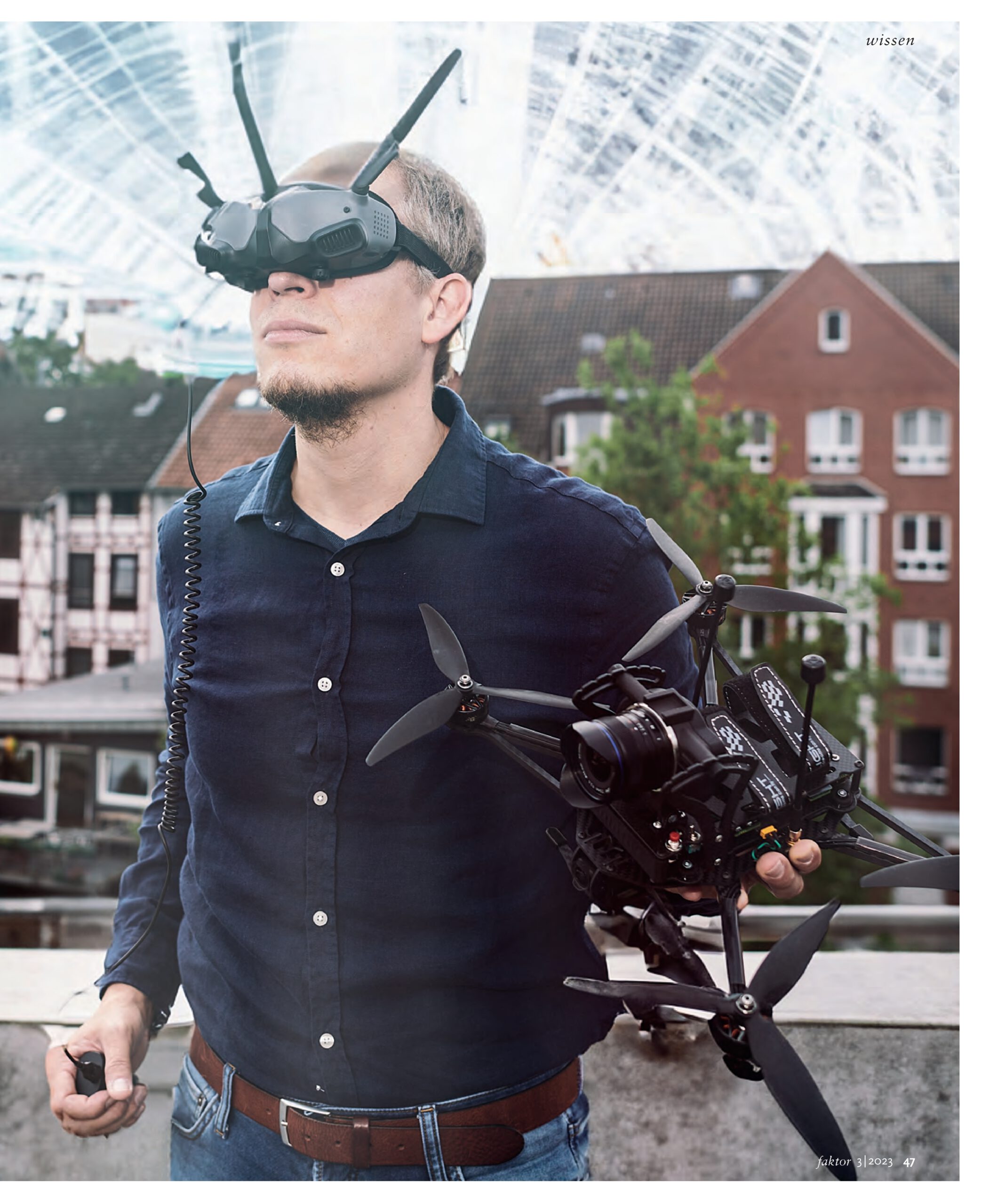
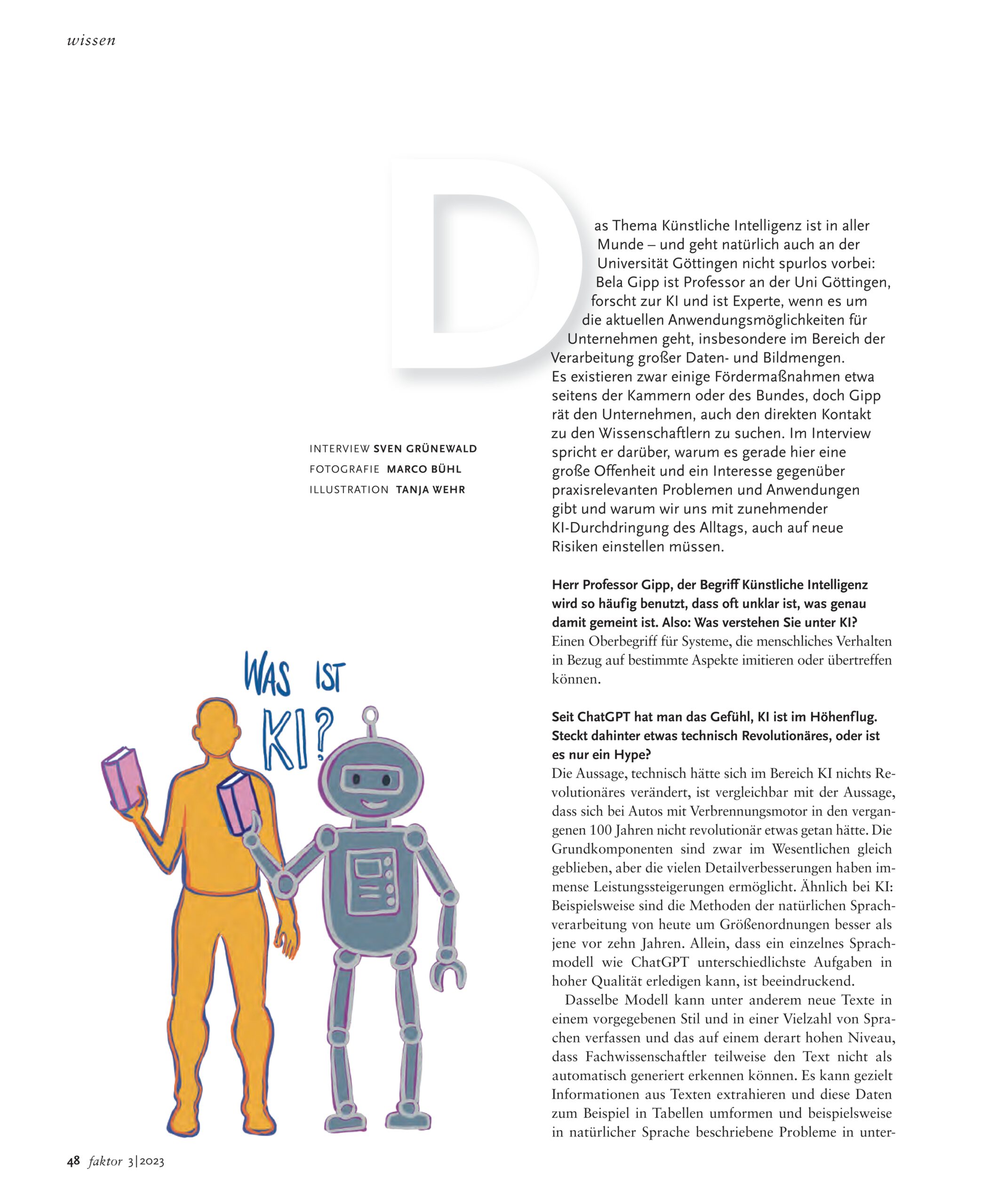
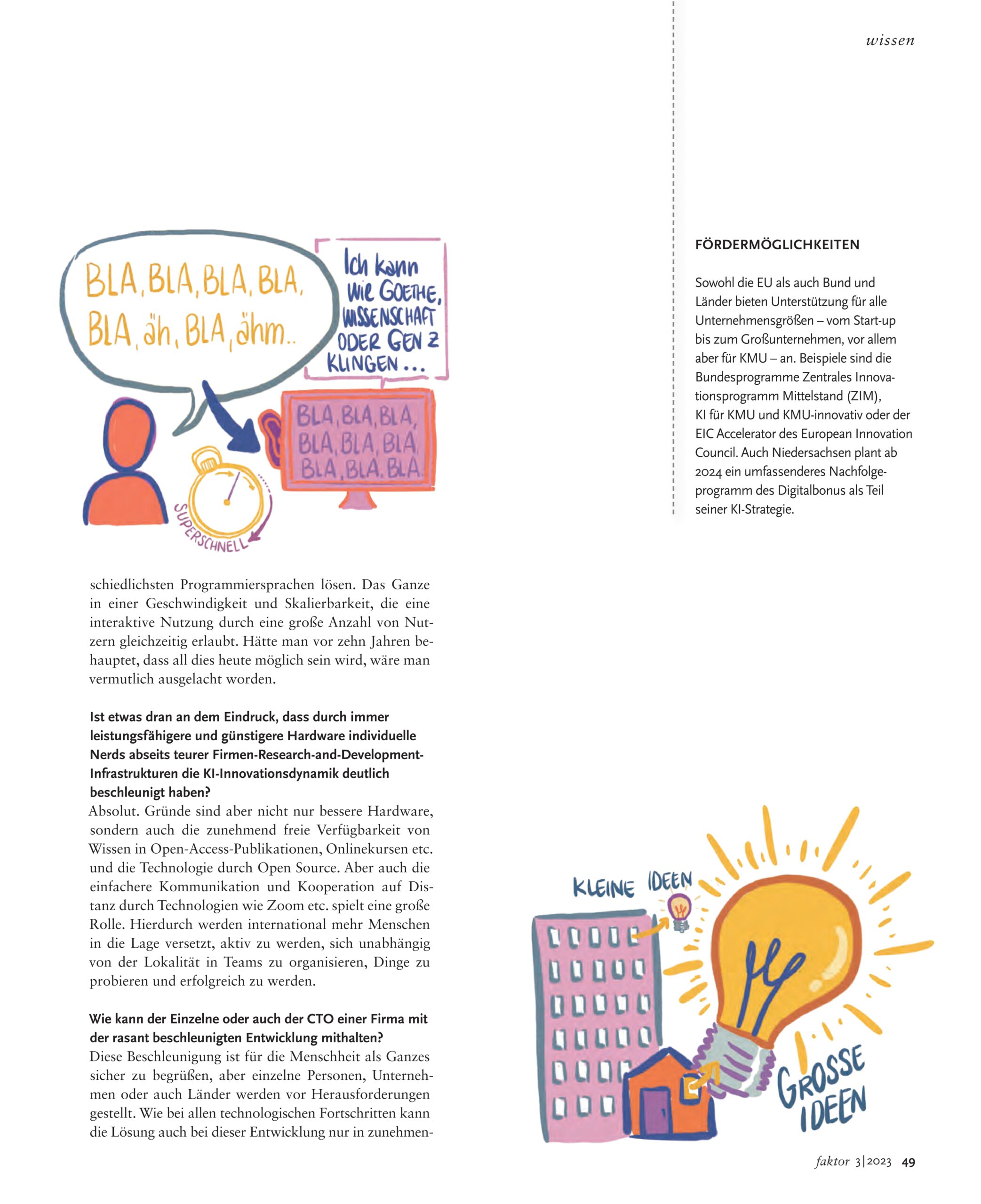
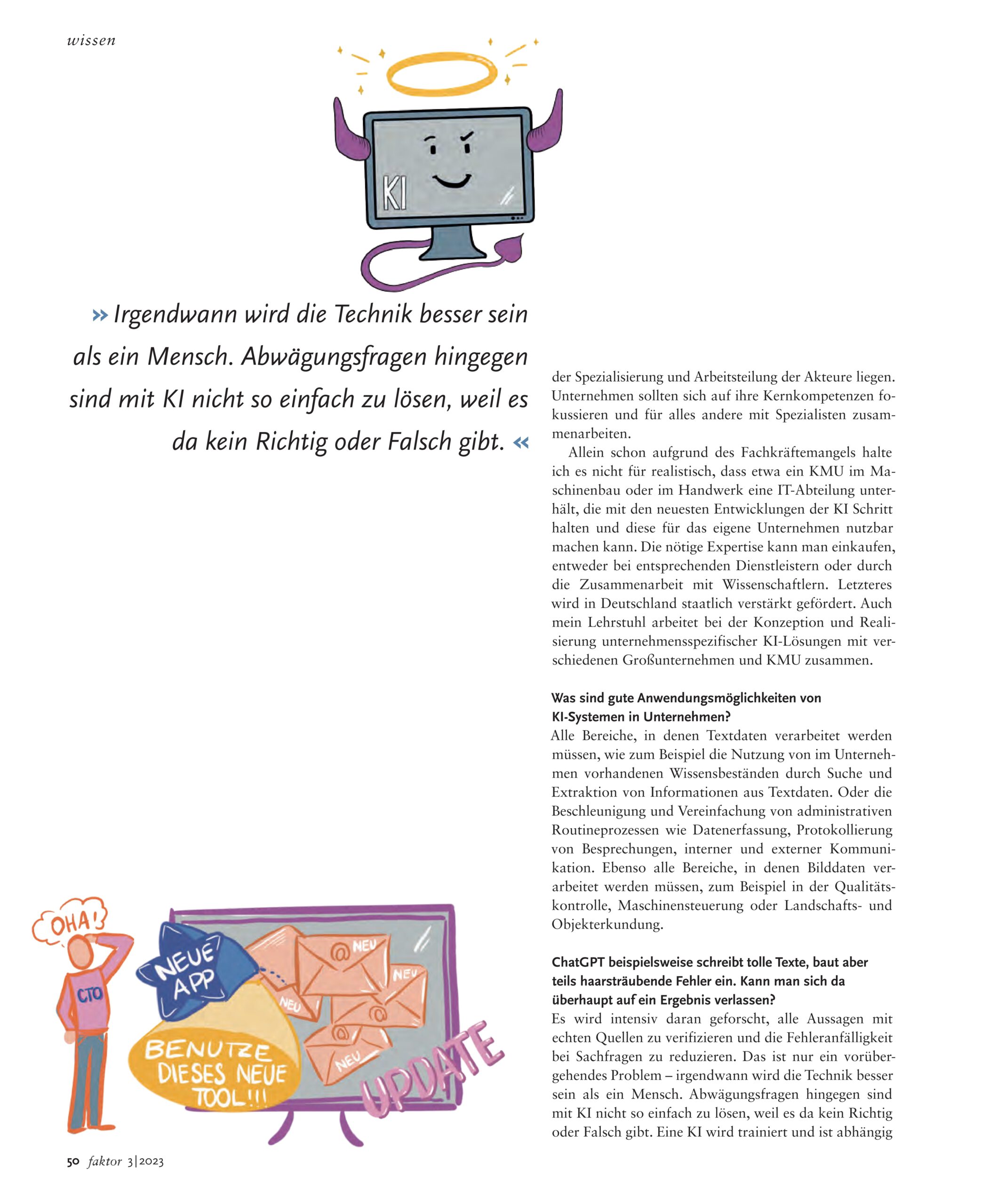
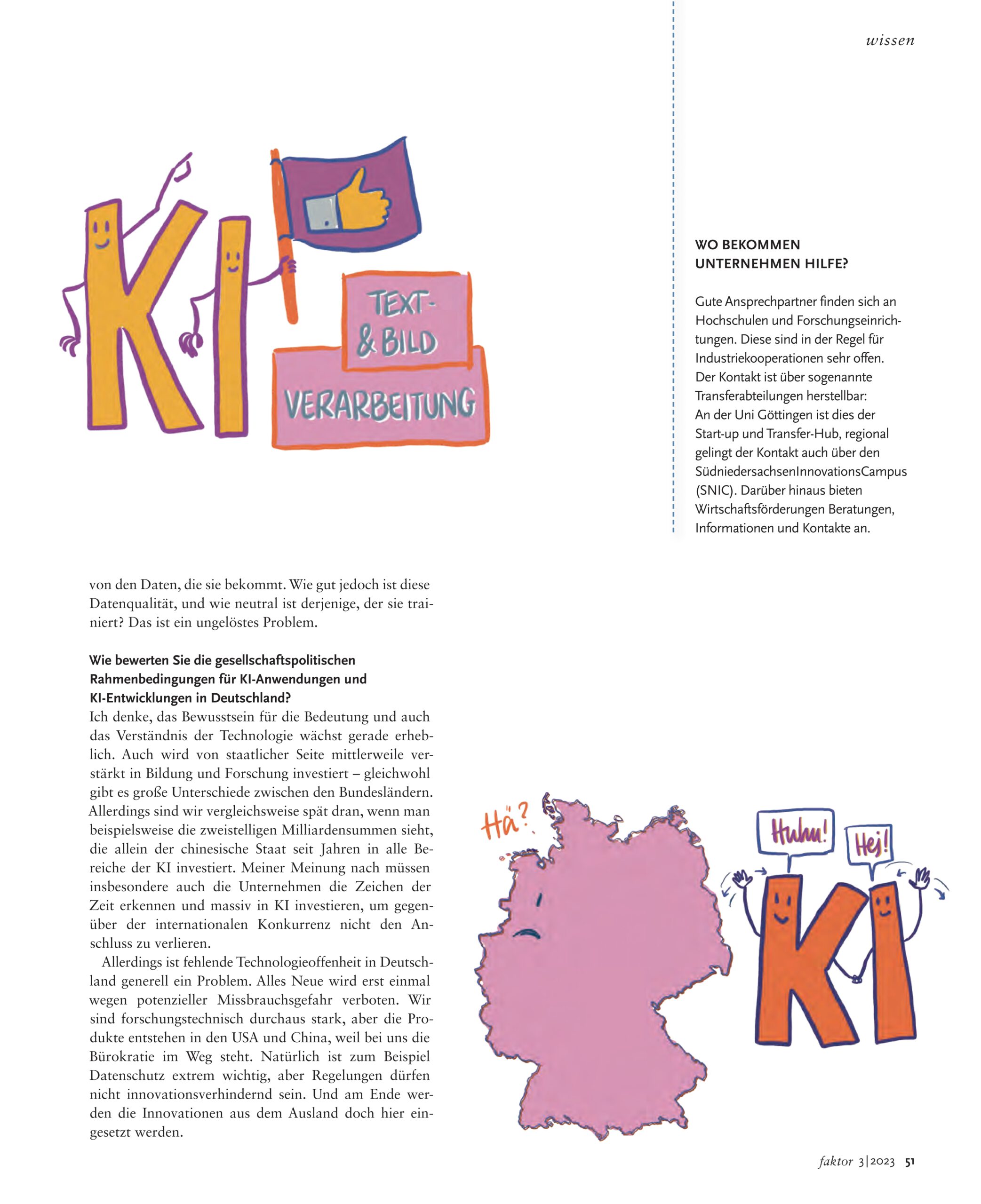
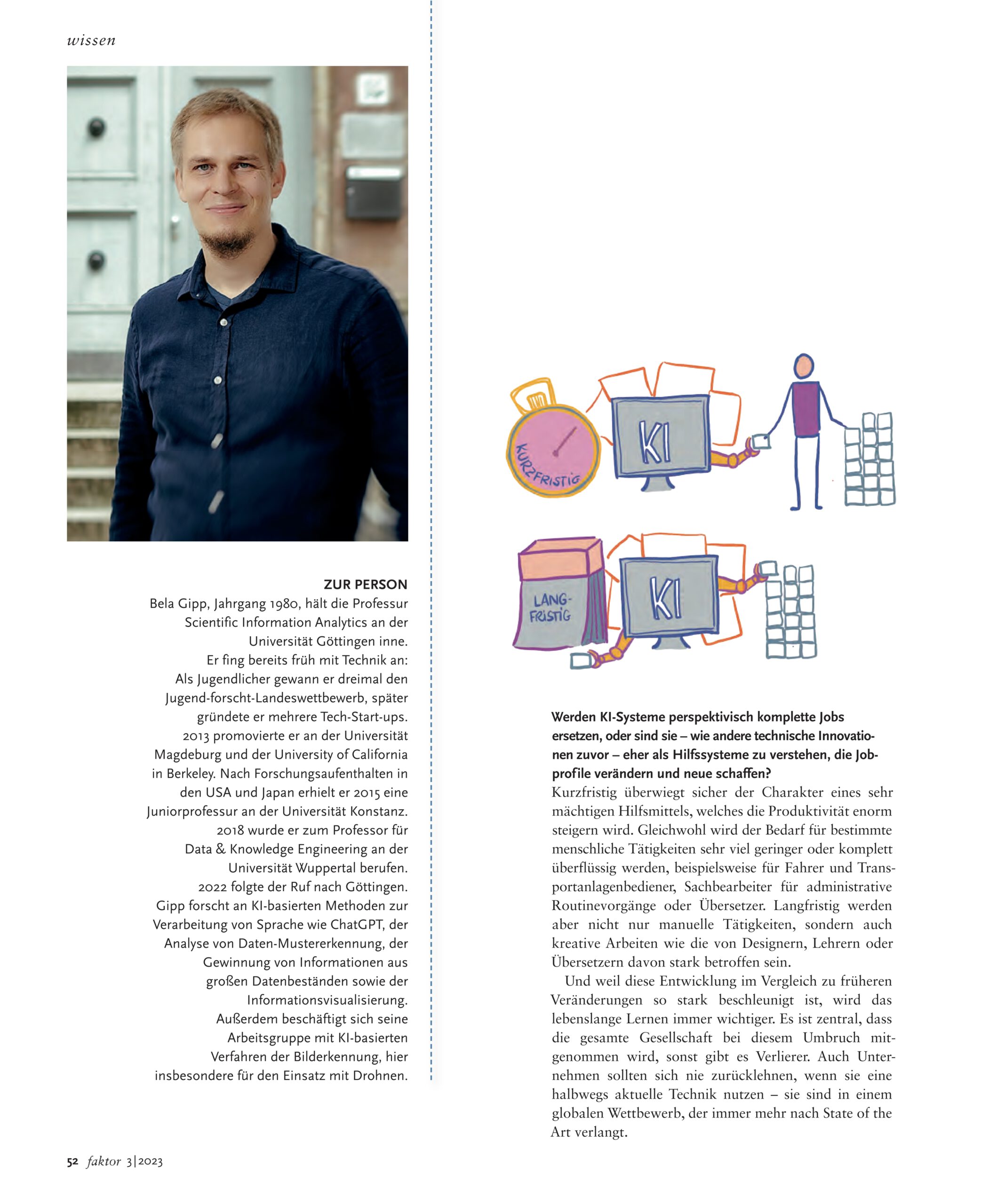
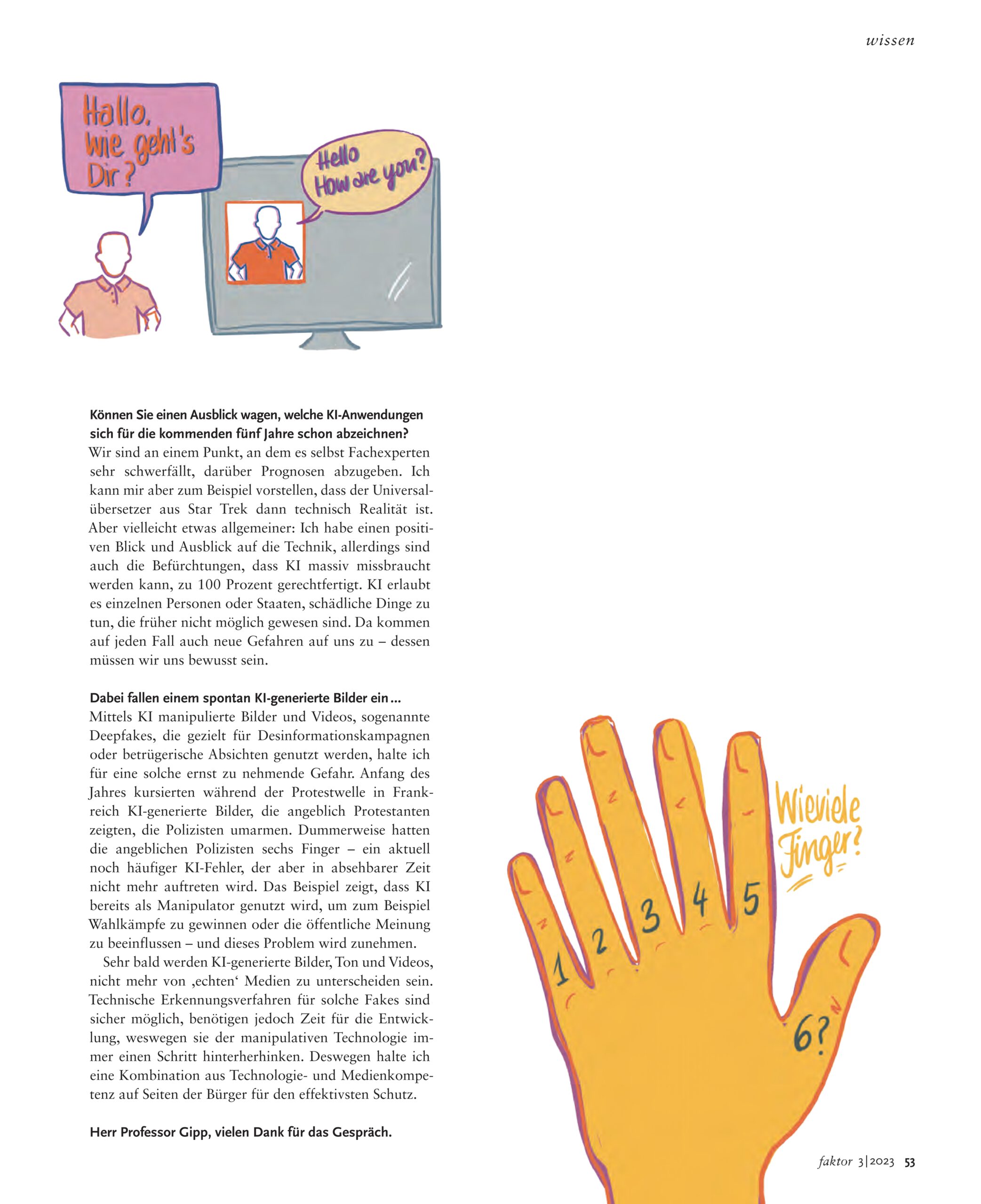
Interview with Bela Gipp: “Fehlende Offenheit ist das Problem”
Read the full article as here or in the faktor magazin.
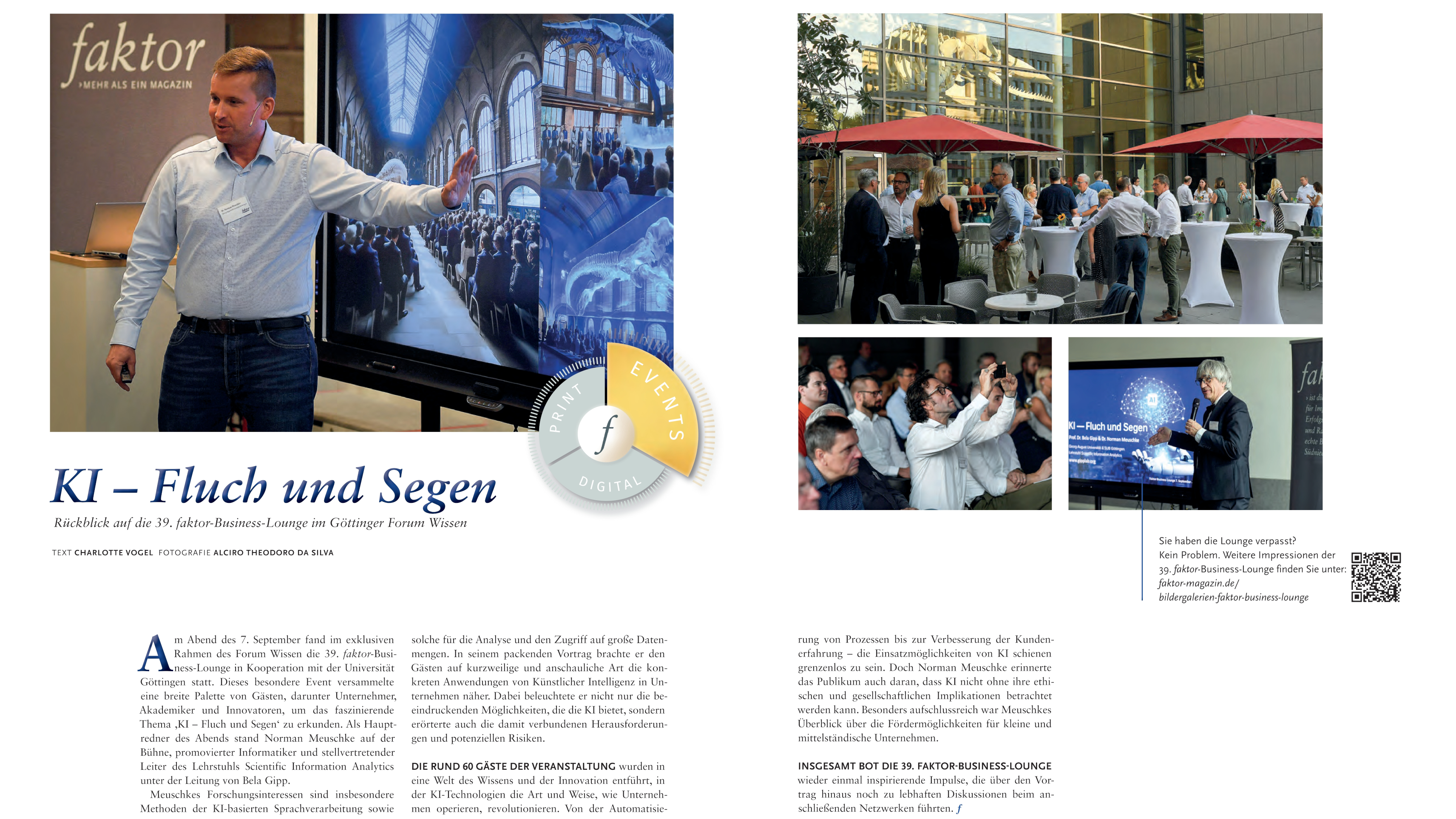
Talk: KI — Fluch & Segen at faktor Business Lounge
Norman Meuschke gave a talk on the Opportunities and Risks of Artificial Intelligence at the 39th faktor Business Lounge. Read the report about the talk here or in the faktor magazine.
NDR Synapsen Podcast with Bela Gipp and Norman Meuschke
Bela Gipp and Norman Meuschke recently appeared on the ''Synapsen'' Science Podcast by NDR Info. Alternatively, you can listen to it on the NDR website. The topic of the episode was: Keine Angst vor Künstlicher Intelligenz? The podcast [...]
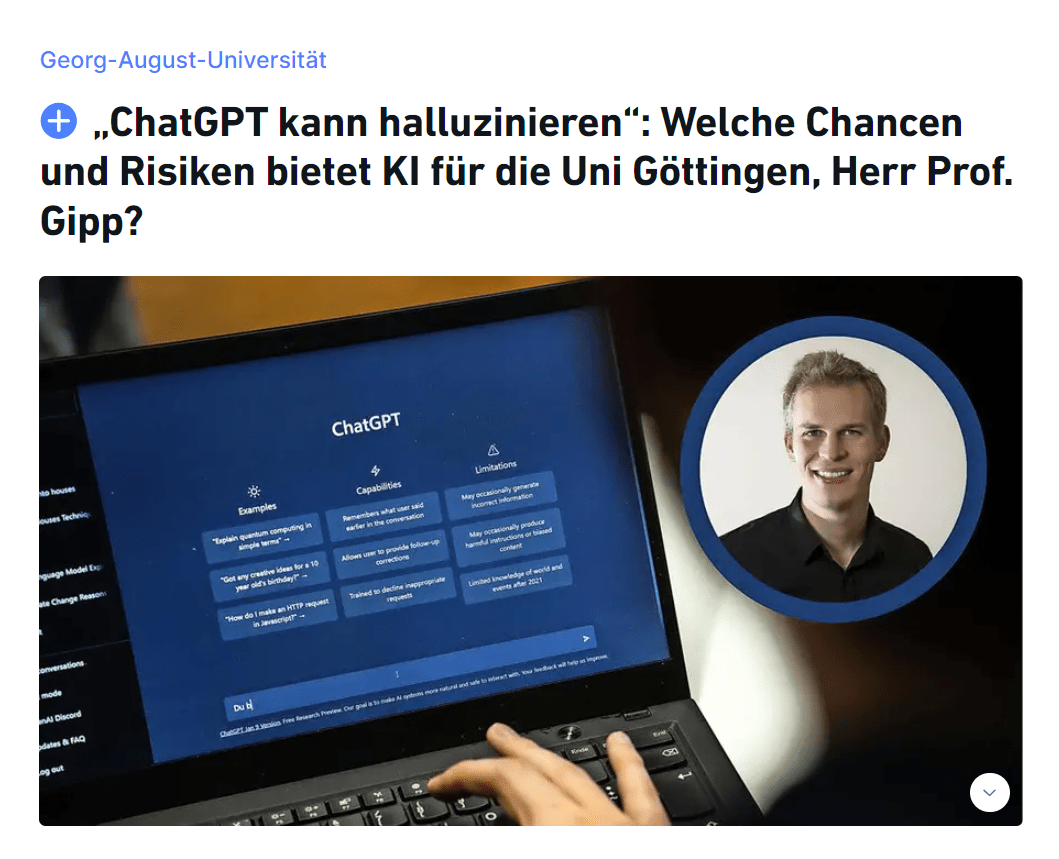
Interview of Bela Gipp on the Opportunities and Risks of AI for University Teaching
The local newspaper, Göttinger Tageblatt, interviewed Bela Gipp on the opportunities and risks of AI for university teaching. Read the article here or online.
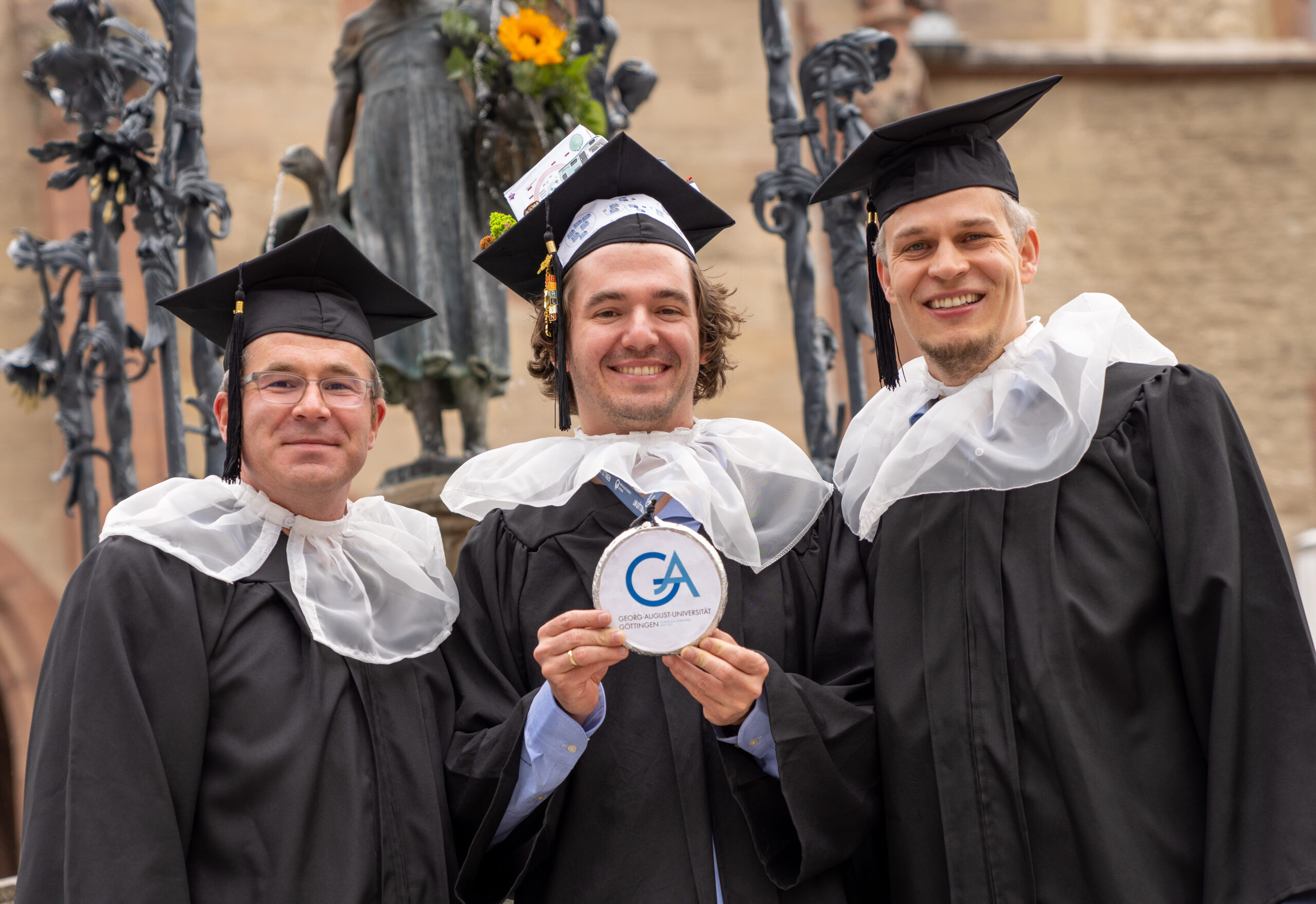
Malte Ostendorff Receives his PhD
We are delighted to announce that Malte Ostendorff has successfully defended his PhD thesis titled ‘‘Aspect-based Document Similarity for Literature Recommender Systems’’ on April 25th, 2023. The research objective of Malte’s thesis was to improve literature recommendation systems by proposing [...]

Invitation to Meet-up on AI in Open Science
Our group will participate in the next Open Science Meet-up on the Role of AI in Open Science organized by the State and University Library Göttingen. Everyone is cordially invited to participate in this free hybrid event (online and in-person). [...]
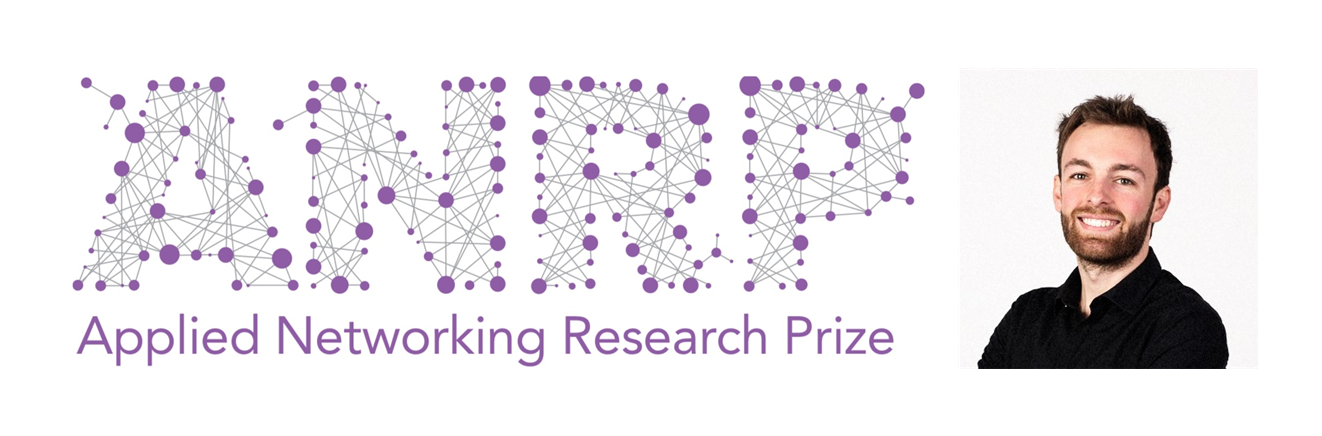
Dennis Trautwein receives the Applied Networking Research Prize
Our PhD candidate Dennis Trautwein has received the prestigious Applied Networking Research Prize awarded by the Internet Research Taskforce. The prize recognizes the best recent results in applied networking and interesting new research ideas with potential relevance to the Internet [...]
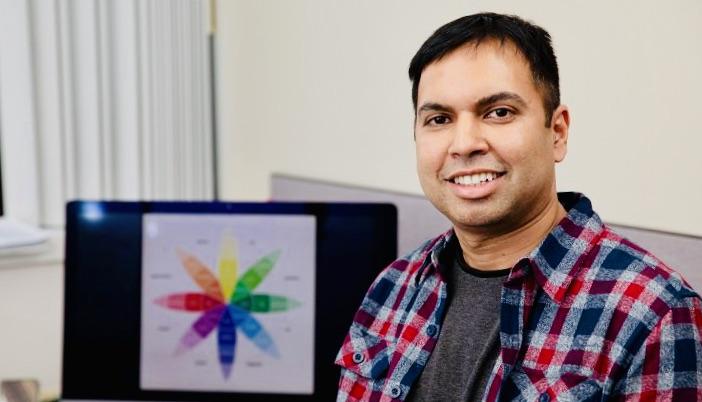
Talk by Dr. Saif M. Mohammad (NRC) on Emotions, Creativity, and Fairness in Language
We are delighted to announce the talk "The Search for Emotions, Creativity, and Fairness in Language" by Dr. Saif M. Mohammad. When & where: December 14, 15:00-16:00 (sharp), Alfred-Hessel-Saal in the SUB's historic building (Campus Map | Google Maps) About the speaker: Dr. [...]
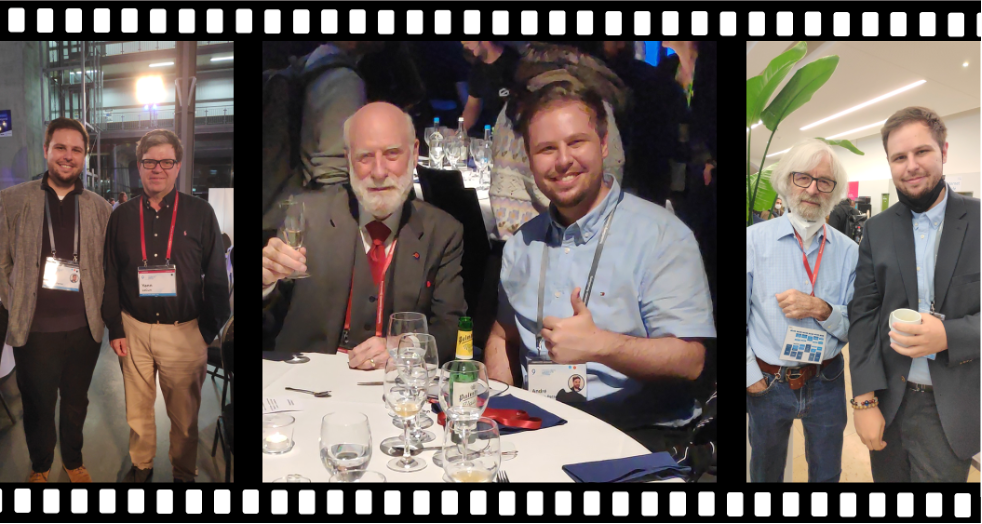
André Greiner-Petter reports from the Heidelberg Laureate Forum
Our group member, Dr. André Greiner-Petter was selected to visit the prestigious annual Heidelberg Laureate Forum (HLF). The HLF is a weeklong conference that gives young researchers the opportunity to connect with international research pioneers and Laureates from computer science [...]
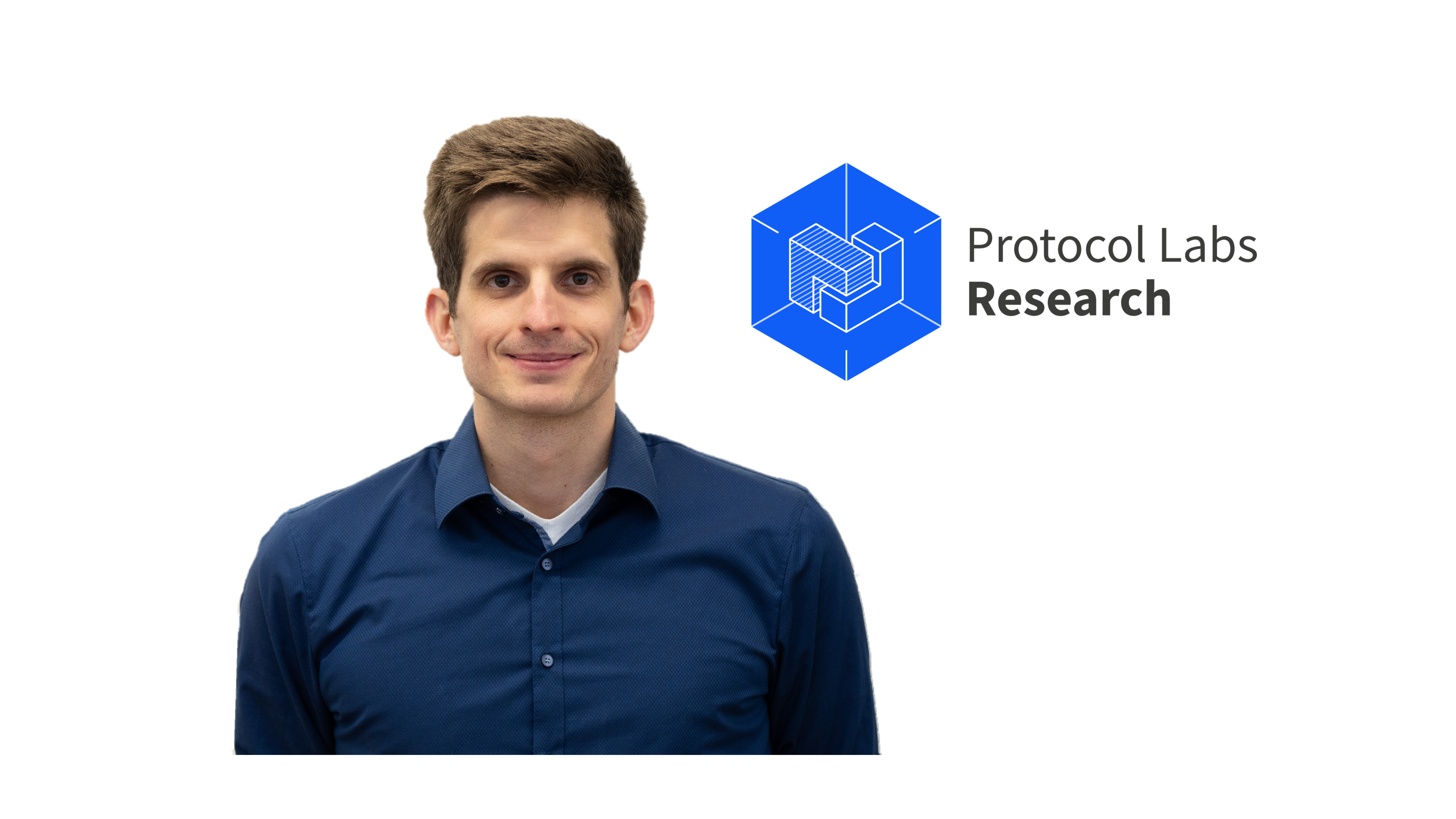
Cornelius Ihle receives two-year PhD Fellowship from Protocol Labs
Our PhD candidate, Cornelius Ihle, has been awarded a two-year PhD Fellowship from Protocol Labs. Cornelius investigates approaches to increase user privacy in the IPFS network.
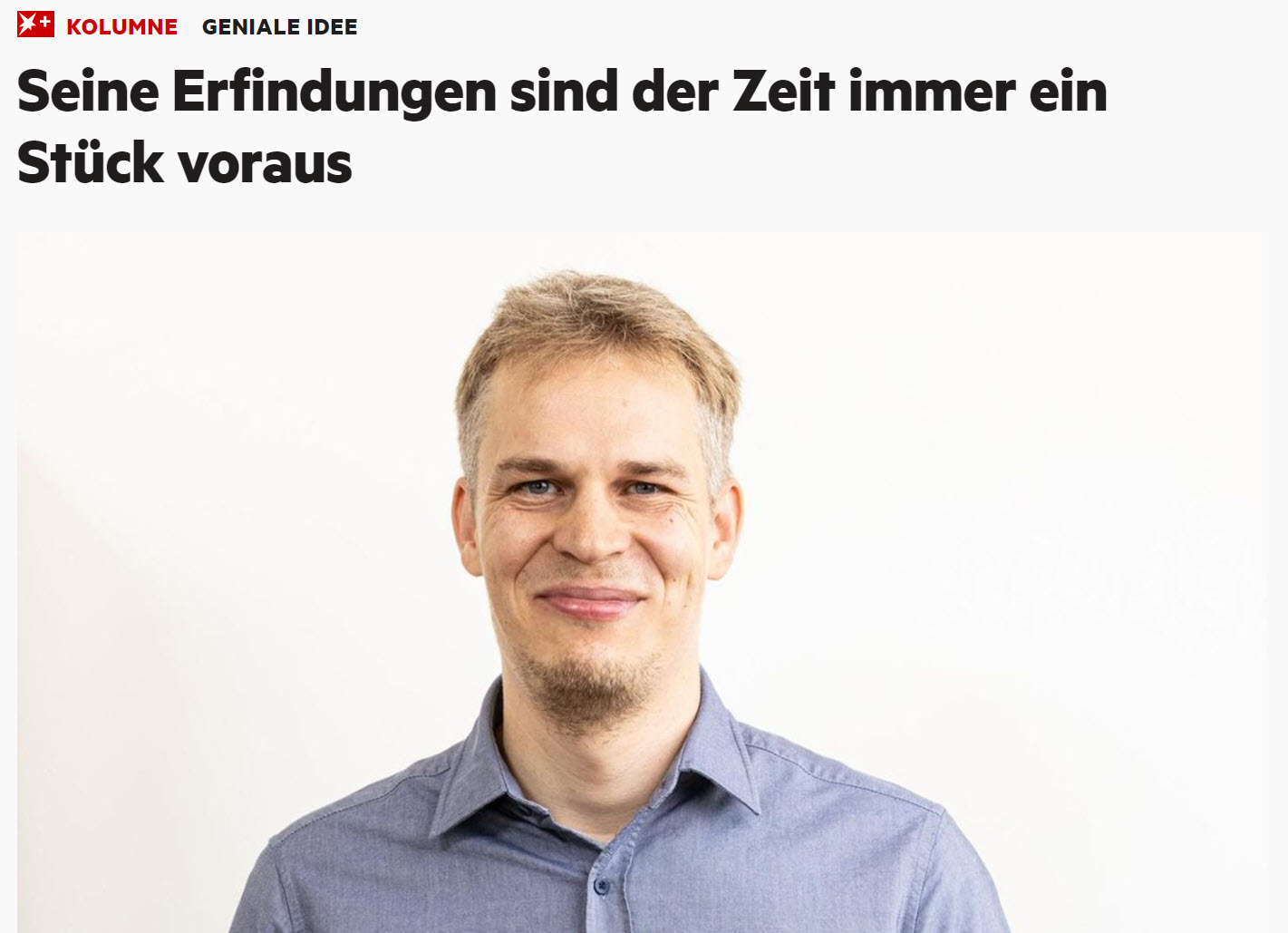
Stern magazine reports on Bela Gipp’s inventions with ”Jugend Forscht”
The German magazine, Stern, just published an article about Bela’s research projects and his inventions while participating in the ‘Jugend Forscht’ competitions as a student. The article also describes one of Bela’s earliest inventions, the “GSM Schutzengel”, with which Bela [...]
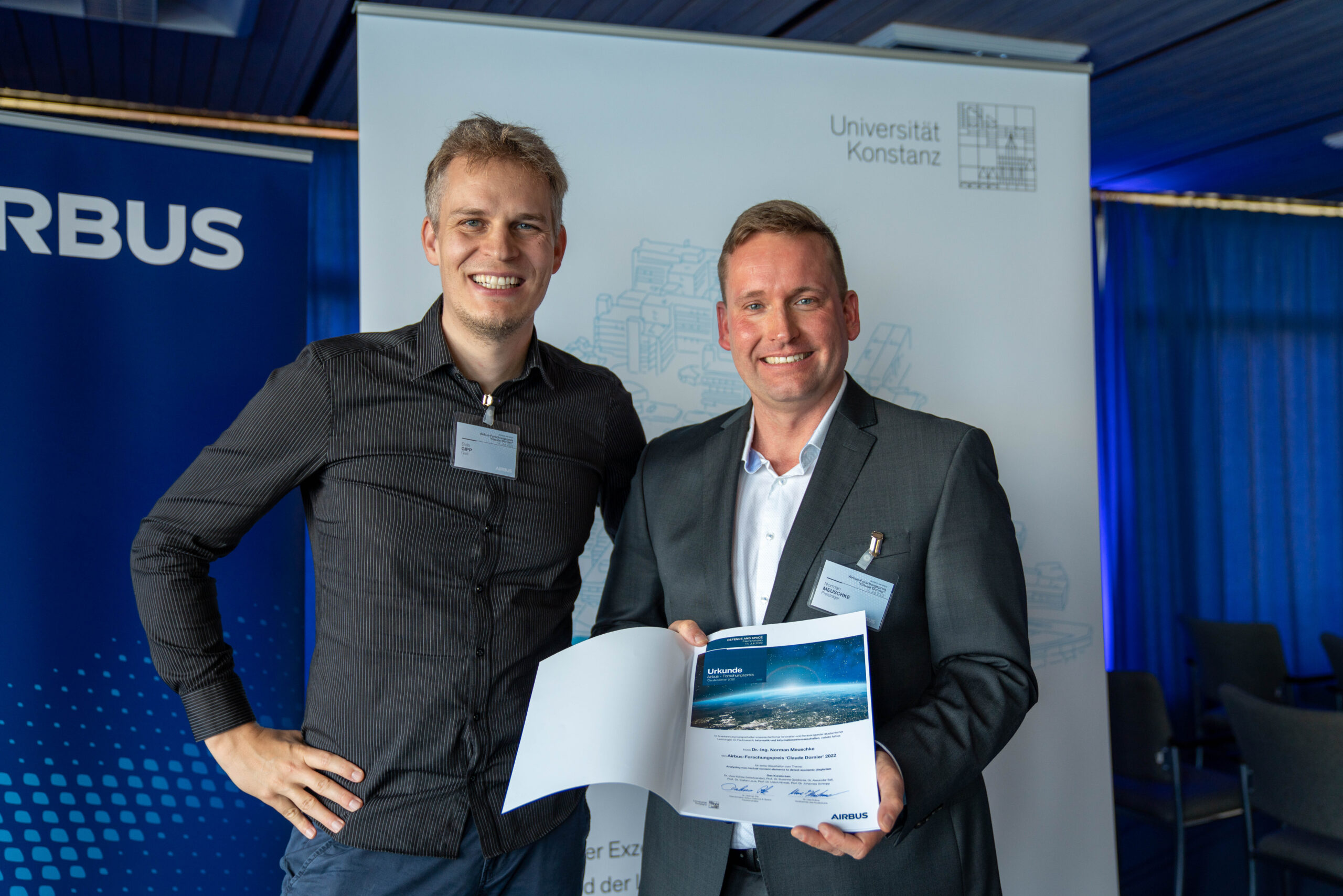
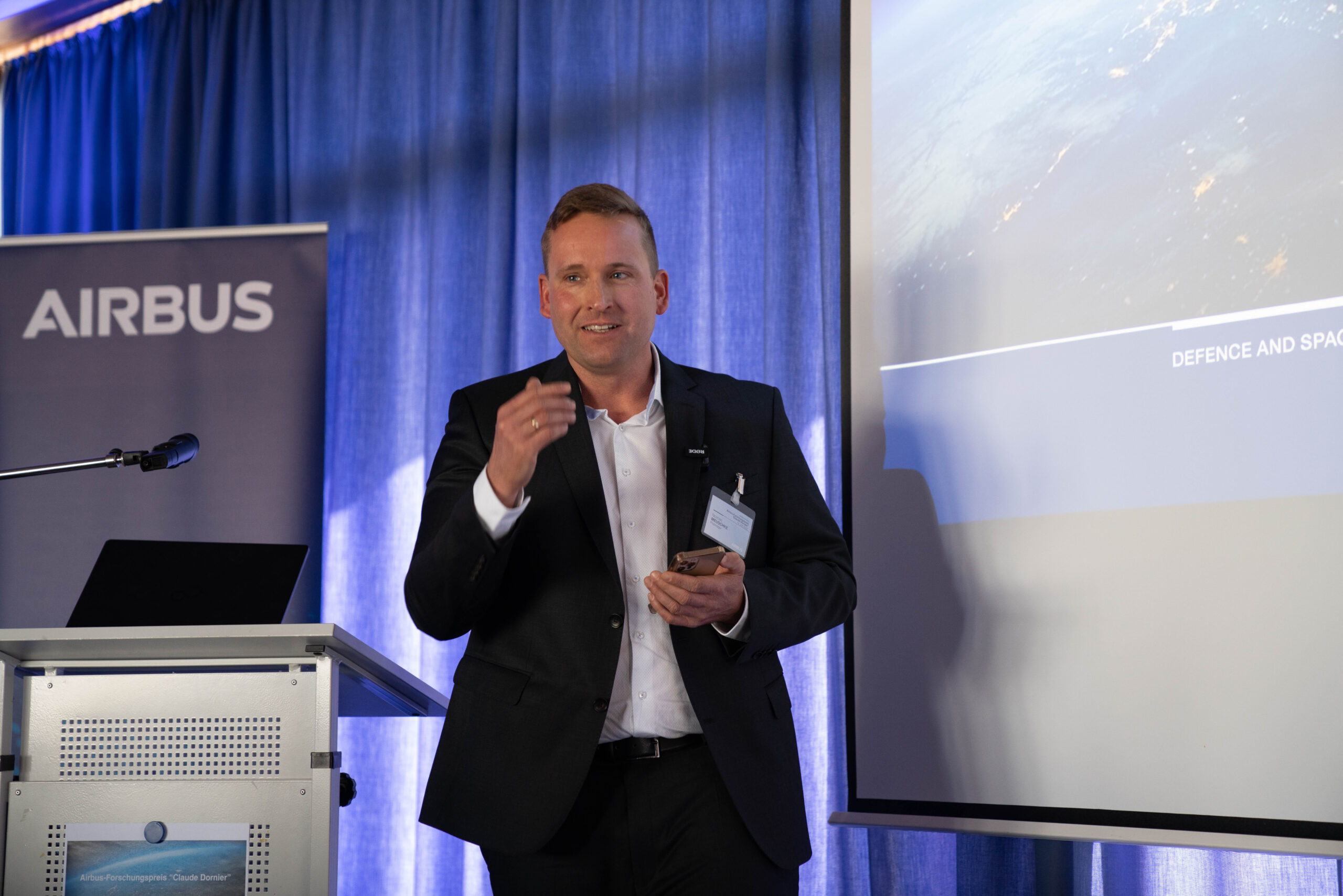
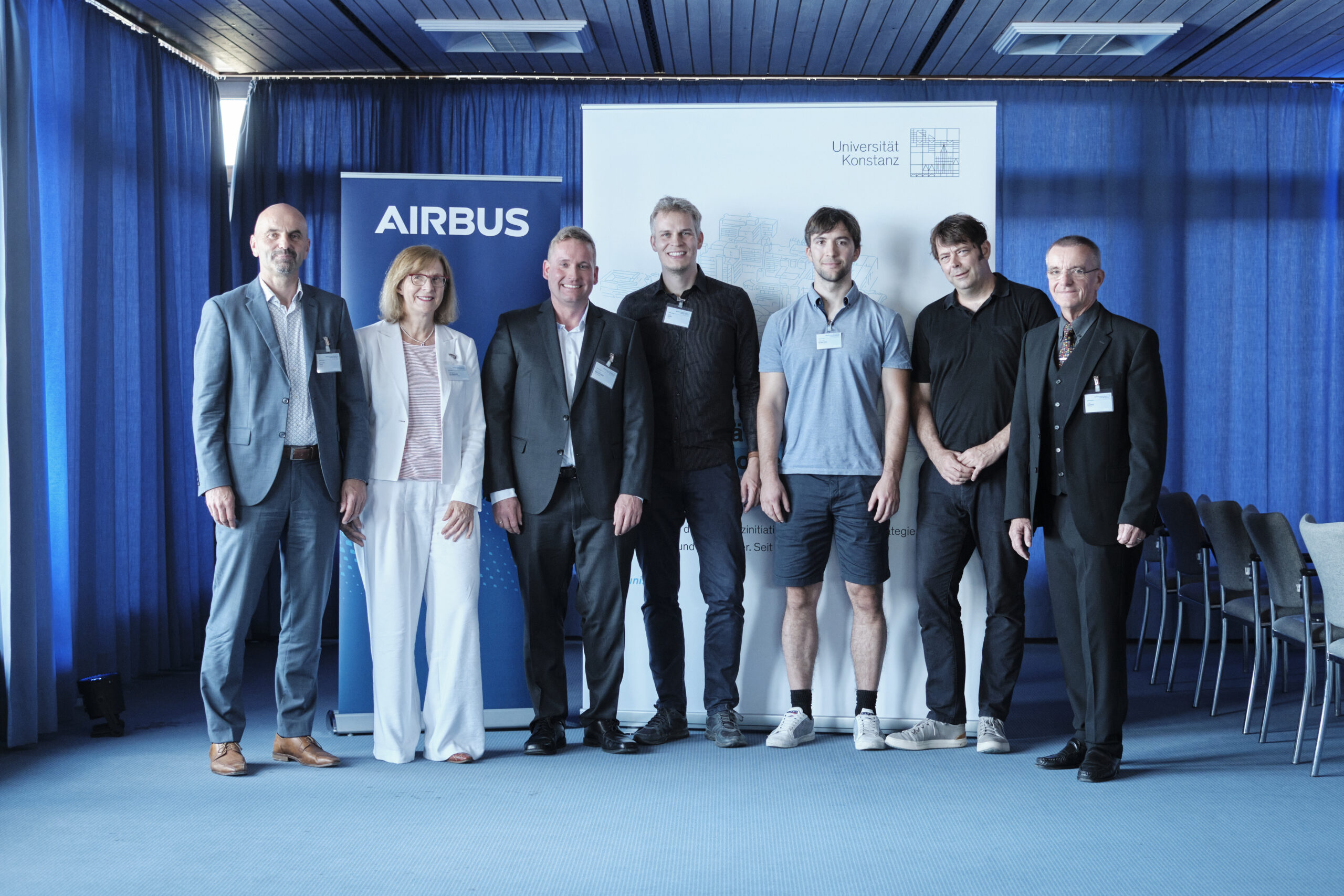
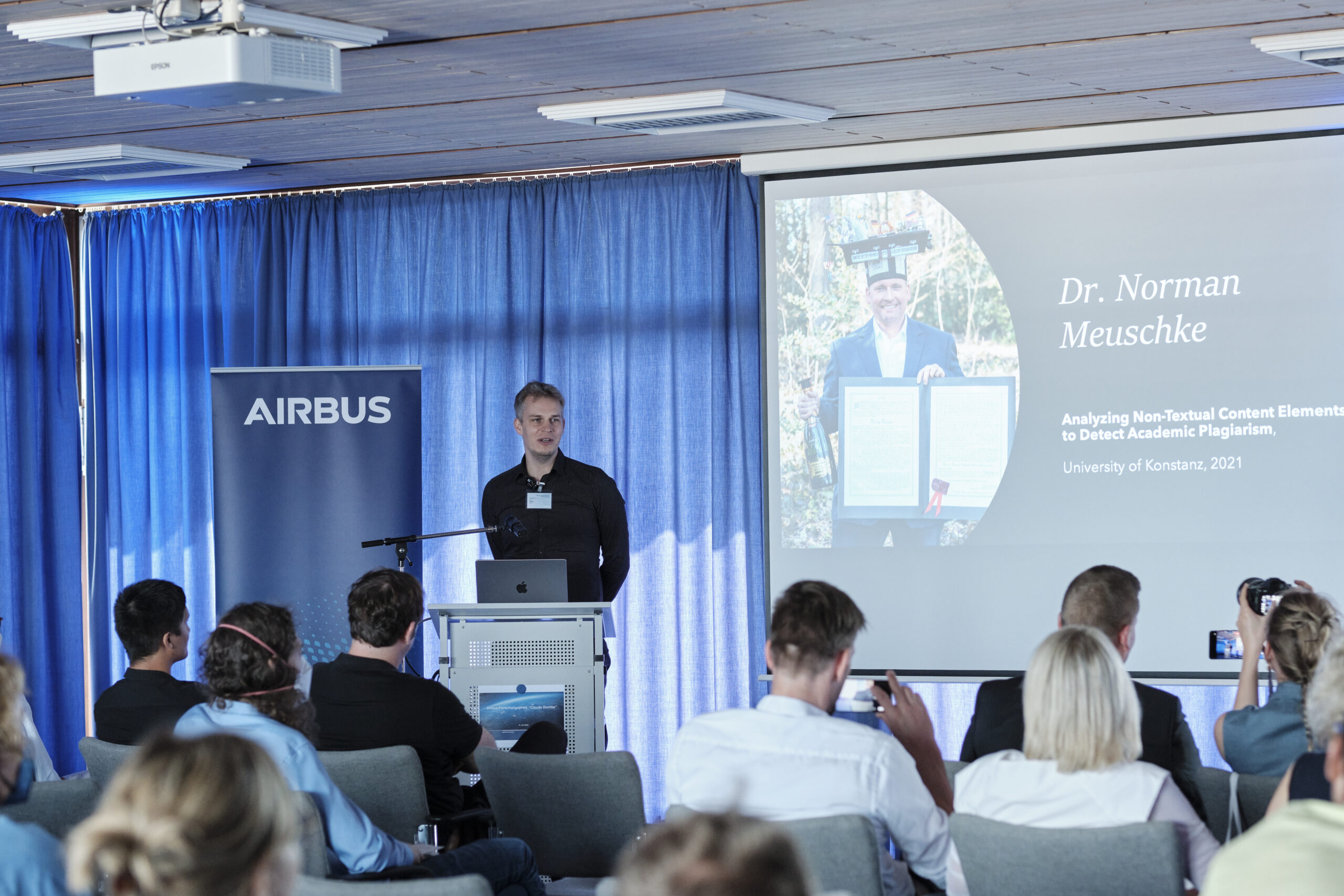
Norman Meuschke receives the Airbus Research Award Claude Dornier
We are delighted to announce that Dr. Norman Meuschke was awarded this year’s Airbus Research Award ‘Claude Dornier’ for his outstanding research achievements during his Ph.D. research. The award ceremony took place on July 14th, 2022, at the University of [...]
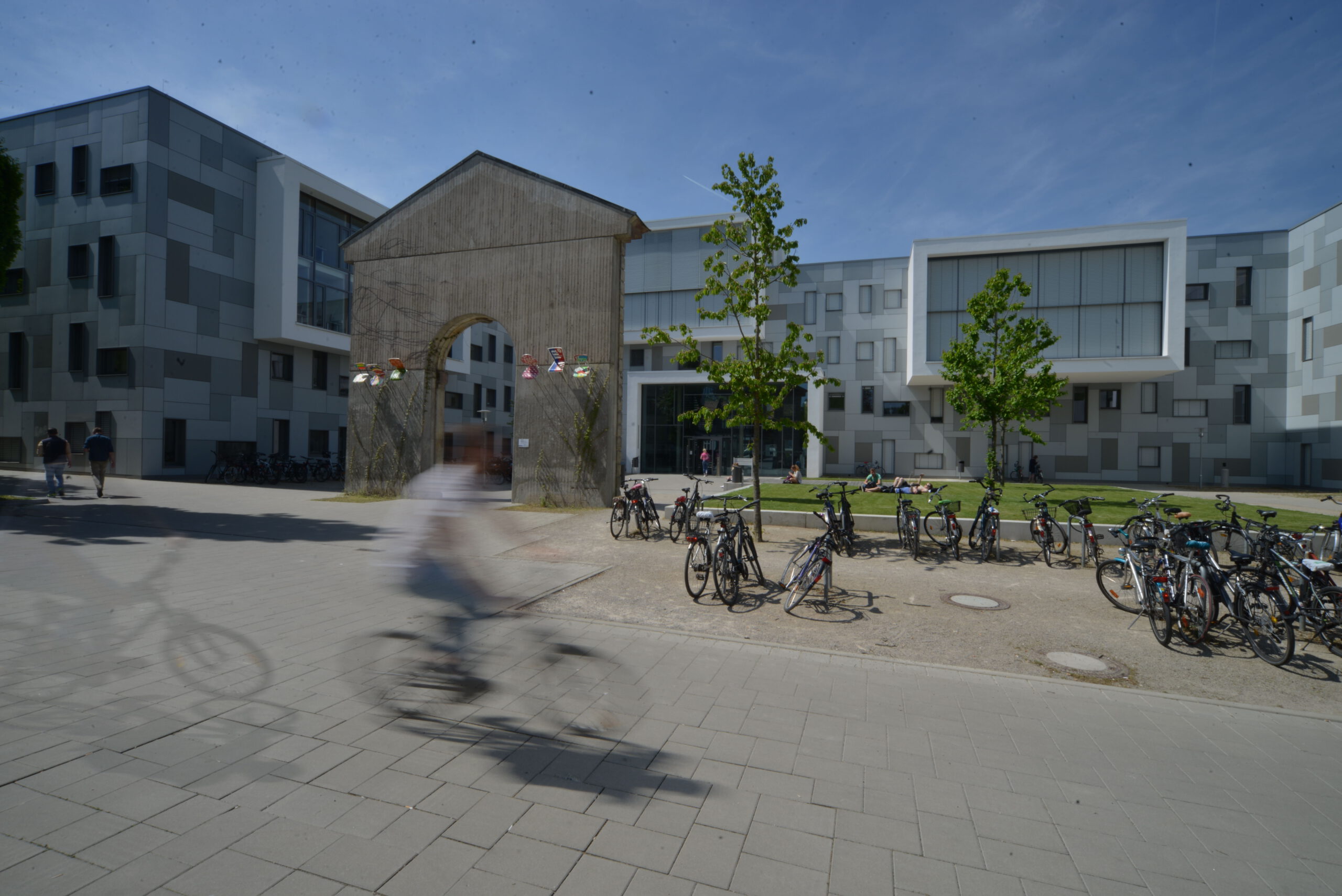
Our research group moves to the University of Göttingen
Bela Gipp has recently accepted a new full professorship at the Georg-August-University Göttingen (Website, Wikipedia page). The new position will be at the intersection of the Department of Computer Science and the research department of the State and University Library (Website, Wikipedia [...]
