


A Spring-Loaded Switch for Autonomous UAV Charging
Student project in the Advanced FPV Quadcopter Course by Finnley Hartz & Tobias Plattner, Summer Semester 2026.


Intro
A UAV’s mission is only as long as its battery lasts, and most charging stations only work with one narrow class of drone, because they impose requirements regarding landing gear, size and weight, which all have to match the station’s design. This project separates the charging mechanism from that constraint. A small adapter switches a UAV between its flight circuit and a charging circuit using a spring-loaded carriage and magnetic pogo-pin contacts. It is built from cheap, mostly 3D-printed parts, and does not require any gear or computation (like vision) from the drone itself.
This project was developed during the Summer Semester 2026 as part of the Advanced FPV Quadcopter Course (6 C).
About
Charging stations for autonomous UAVs usually work the other way around: the station is built to match one drone’s landing gear, so a different drone, or a fleet of different drones, needs a different station. We wanted to break that dependency, so we designed a small adapter that sits between the UAV’s battery and its flight controller, rather than a full docking station. We believe this is a necessary step to achieve wide application of autonomous UAVs, as procurement and maintenance of multiple different complex systems can become prohibitively costly for fleet deployment, especially if redundancy is desired, or the fleet sports a wide range of different UAVs.
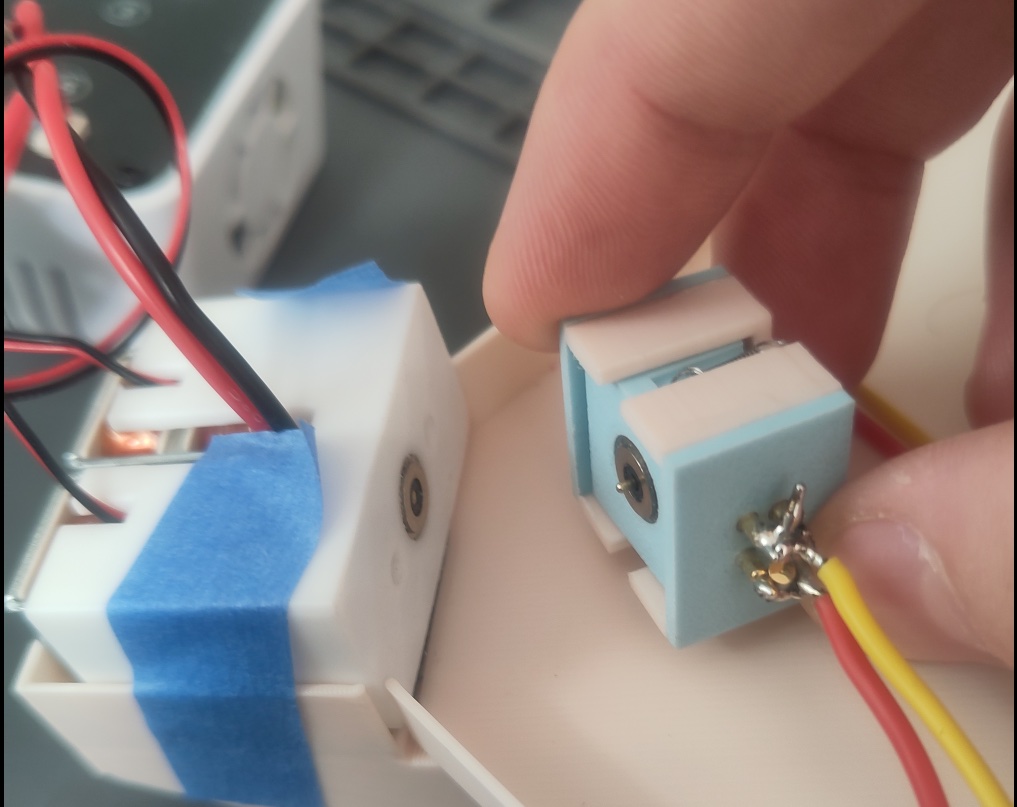
The adapter has two states. In flight, the battery powers the flight controller; docked, the battery is switched to the charger instead. The switch itself is realised mechanically through a spring-loaded carriage that moves when the UAV docks, disconnecting the flight controller and connecting the charging contacts through magnetic pogo pins. A sensor at the station observes the charging current to know when to release the UAV again. The drone itself is not burdened with any computation.
We built two versions to test the idea: a minimal mechanism with as few parts as possible, and an enclosed one meant to be more protective of the internal parts against external forces.


Both were tested attached to one side or underside of a typical quadcopter, running full cycles of docking, charging and release by hand. Both reached all three states reliably and held up over repeated cycles. Though functional, we found both versions to be fragile against concentrated force, and assembly to be hindered by a very low viscosity glue. The main issue was to ensure stable polarity contacts that slide smoothly in both directions, which worked best with the minimal version and copper polarity plates.
This work only covers the charging switch itself, not the landing mechanism that would guide a UAV into position automatically. This is a separate, but crucial, problem to solve, and solving it is what would be needed to make the whole system autonomous end to end.
Main features
- Mechanical switch between a UAV’s flight and charging circuit
- Magnetic pogo-pin contacts for reliable, self-aligning connection
- Spring-loaded carriage handles the flight/charge switch-over automatically on docking and release
- 3D-printed chassis and low-cost parts (pogo pins, magnets, springs, a current sensor and microcontroller on the station side)
- Two working prototypes, tested on a 1S Li-ion cell and a fairly typical quadcopter frame

